
Energy regulators and industry experts warn that the state’s delays to major projects amid backlash from residents could create rolling blackouts and strangle growth of other industries that need power.
For the first time in five years since Winter Storm Uri turned the electrical grid into a political albatross for Texas leaders, the state’s grid has again become a liability for politicians.
Many residents don’t want data centers in their communities, fearing their massive energy, water and land use, a majority of which is planned for rural Texas. Many residents are also balking at transmission lines lawmakers approved to build hundreds of miles across West Texas because they threaten to eat up their land.
The pushback has gotten so overwhelming that the state’s top leaders — the very ones that welcomed these initial proposals with open arms — have called on regulators to delay these projects.
But in this abrupt bid to assuage constituents’ concerns, state lawmakers could be shortsighted.
The Electric Reliability Council of Texas, the state’s grid operator, has said West Texas is at risk for rolling blackouts if these lines don’t get built, and residents will face higher energy prices as congestion worsens. The oil and gas industry says its ability to expand will be hamstrung without the lines’ construction. And, pushing pause on data centers has created uncertainty in other industries that want to connect to the grid but are unable to know if or when they will get it.
“Whatever the complexities of the policies engaged here — and the degree to which the deployment of these high-capacity power lines and the construction of data centers are distinct issues — in this moment, it’s the politics that matter at least as much as the policy,” said Jim Henson, director of the Texas Politics Project at the University of Texas at Austin.
In recent weeks, dozens of legislators and state officials have called on the transmission line buildout to be scrapped entirely so the Legislature can return to the drawing board. And Gov. Greg Abbott announced an audit of data centers seeking to be connected to the power grid that has forced ERCOT to pause a first-of-its-kind effort to rework its queue for facilities seeking energization. This delay has made grid planning harder and left industries unclear if or when they will be able to receive power from the grid, risking economic development from data centers and traditional industries alike.
The political stakes are too high for lawmakers ahead of the November election to defy the wishes of local residents, most of whom are concentrated in rural areas where these controversial transmission lines and data centers are being built, Henson added.
“We should expect that political leaders are going to be responsive in election season,” Henson said. “That’s how democracy works. We expect that responsiveness, and I think we’re seeing it.”
Transmission line needs
Most of the public learned the fragility of the Texas grid in February 2021, when Winter Storm Uri forced ERCOT to implement rolling blackouts to prevent a total grid collapse, leading to $80 billion to $130 billion in economic damage and 246 deaths.
The disaster prompted legislators to pass a slew of bills aimed at making the grid more reliable by encouraging new power generation to be built and requiring companies harden existing generators against bad weather. As electricity generation increased, regulators also asked the Legislature in 2023 to sign off on a plan to greatly expand the state’s transmission capacity so that additional electricity could be better distributed to customers around the state.
The Public Utility Commission later approved a plan to build 765 kilovolt transmission lines across the state to meet those transmission needs, a type of transmission line larger than any previously built in Texas.
Oil and gas operators in West Texas had long worried about transmission capacity in West Texas, which has far less generation capacity than the more populous eastern half of the state. Oil and gas production has skyrocketed in Texas, a milestone that industry leaders said can’t be sustained if the state doesn’t build more power infrastructure.
“The world’s most important energy basin is currently running on a patchwork of portable generators that just are not equipped for long-term needs or production growth,” said Todd Staples, president of the Texas Oil and Gas Association.
Now facing potential delays, those concerns are growing by the day. The PUC’s independent market monitor, Potomac Economics, found the West Zone average demand grew 12.3% in 2025 versus 6.1% statewide. Congestion inside the zone rose 27% that year, and the region posted ERCOT’s highest average annual energy prices for a second straight year.
Legislators opposed to the lines and grassroots advocates have pushed back on the oil and gas industry’s concern, saying those companies can use its access to natural gas to build power plants that could power the region. However, the construction of a new natural gas power plant faces lengthy delays due to supply chain constraints caused by rising energy demand globally.
The grid constraints are already slowing the growth of the industry, and reliability concerns are mounting.
ERCOT Senior Vice President and Chief Operating Officer testified in July that rolling blackouts are possible in the Permian Basin by next summer.
A letter authored by the oil and gas association, the Texas Chemistry Council, the Texas Association of Manufacturers and electric company associations reiterated those concerns to Abbott, Lt. Gov. Dan Patrick and House Speaker Dustin Burrows. Patrick is among a group of legislators that have called on the Public Utility Commission to reject the proposed lines outright.
“Reliability failures, congestion and operational limitations ultimately impose costs on Texas consumers that can exceed the cost of prudent, timely infrastructure investment,” read the letter, sent Wednesday. “Avoidable delay is not a neutral choice for ratepayers; it is a choice between paying for planned infrastructure now or paying more later through outages and congestion.”
Those concerns are not limited to West Texas.
In the Houston area, electricity demand is also growing rapidly due to industry and the region’s growing population. Electricity rates are already elevated due to transmission congestion, according to ERCOT.
Most of the debate over the lines has been limited to three routes planned for West Texas, the first phase of the buildout that is further along in the process. A second phase is planned that will construct a loop of 765 kV lines in the eastern half of the state, intended to relieve transmission congestion in the state’s largest cities.
Source: , The Texas Tribune
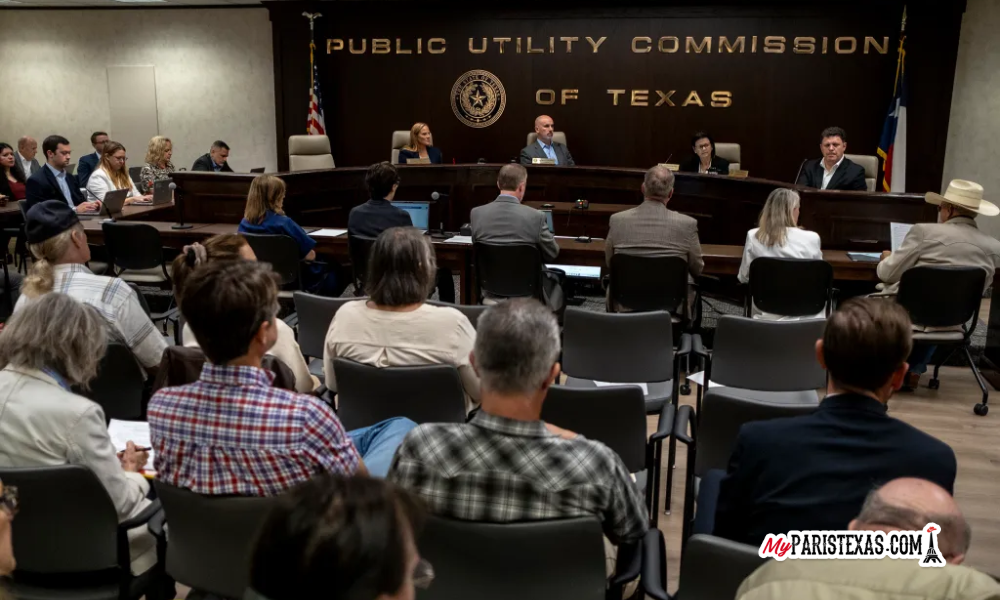
Photo Credit: Commissioners of the Public Utility Commission of Texas listen to public comment during a special open meeting in Austin on Aug. 14, 2026. Joel Angel Juarez for The Texas Tribune
The Texas Tribune is a nonprofit, nonpartisan media organization that informs Texans — and engages with them — about public policy, politics, government and statewide issues.