
Rural Republicans have long undercut Democrats’ gains in cities and suburbs. Will enough defect to make a difference this fall?
Joie Miller moved to rural Grimes County to raise her daughter hunting, fishing and spending time with her grandparents on their 100-acre ranch. Then Elon Musk announced he was constructing the world’s largest building a little more than a mile from her in-laws’ property.
The Terafab semiconductor factory, which Musk has projected will be 50 times larger than the Pentagon, will produce computer chips for artificial intelligence. As construction kicked off, trucks rumbled past their property day and night. Big chunks of ash rained down.
Miller, 31, started investigating, joining the ranks of outraged rural Texans who have seen wide open spaces suddenly sold off to support the state’s rapacious growth. The more she dug, the more Miller, a born-and-raised Republican, came to blame the party that’s run the state her whole life.
“You just look around and think, are things better or worse, and if they’re worse, who has been in charge?” she said.
Rural Republicans have long been the floodwall that’s held back hopes of a blue wave big enough to flip Texas. While they make up less than one-fifth of the electorate, rural voters turn out and vote red at such high rates they’ve reliably undercut Democratic gains in cities and suburbs. In what’s shaping up to be a razor-tight midterm election, Republicans are counting on these votes more than ever to hold onto Texas’ powerful statewide offices.
But some rural voters are revolting, angry over the sudden proliferation of data centers, massive power lines and other physical manifestations of the state’s relentless development.
Miller said she’s planning to vote Democratic for the first time in her life.
“The Republican Party doesn’t seem to care about us right now,” Miller said. “They do this every single time, where they say they’re going to fix a problem, despite having had decades to fix it, and I think a lot of us are sick of it.”
As early voting kicks off, the rural Republican firewall is showing its first real cracks since the Obama era, the last time a statewide Democrat broke 25% of the rural vote. James Talarico and Gina Hinojosa, the Democratic nominees for U.S. Senate and governor, are polling north of 30% in rural Texas, with Talarico hitting 42% in a late-September Fox News survey.
But it will take a lot of Joie Millers to change Democrats’ fate.
When he nearly bested Sen. Ted Cruz in 2018, Democrat Beto O’Rourke won a narrow majority of non-rural counties but was undone by Cruz’s 75% share in rural Texas. O’Rourke would have had to swing the rural margin 15 points in his favor to have changed the outcome, a Texas Tribune analysis found.
This cycle, Democrats are proposing a marriage of convenience to frustrated moderates, open-minded independents and disenchanted MAGA populists, asking them to put aside culture war differences in the face of shared causes, like data centers.
“If Democrats break through in rural Texas, it will be because Republican leadership was caught flat-footed by a new issue,” said Ali Zaidi, a Democratic political consultant who oversaw rural outreach for Mike Collier’s 2018 and 2022 lieutenant governor races. “Because on the fundamentals — low taxation, business climate, conservative values — they’ve got those locked down and there’s nothing a Democrat can do to explain that away.”
“It’s hard enough to get people to trust me”
On a recent Tuesday afternoon, half a dozen people gathered in a conference room in Corsicana, an hour southeast of Dallas, in dusty boots and business suits. They came armed with binders and printed dossiers, meticulously laying out their investigations into the data centers that are popping up across their communities. They’d documented persistent noise pollution, diminished air quality, spiking electricity bills and ignored pleas for help from the state.
These diehard Republicans were meeting with Hinojosa, they said, because they didn’t know where else to turn. Over the course of an hour, she didn’t ask for their vote. Instead, she gave them what every voice in the wilderness really wants — undivided attention.
“Talk to me like a dummy,” she said, as she put on her glasses to review their findings. “I can tell you’re in deep, and I’m sorry you had to get so educated on this.”
When Hinojosa, an Austin state representative, signed on to face three-term incumbent Gov. Greg Abbott, it seemed like a suicide mission. A fundraising juggernaut, Abbott began the year with over $100 million in his campaign account and a record of smashing his Democratic opponents by double digits.
But few expected the data center curveball, least of all Abbott, who vowed last year that Texas would become the “epicenter of AI development.” In the face of rural rage, Abbott backtracked, temporarily pausing new projects and recommending the Legislature enshrine what he says are the toughest guardrails in the country on water and power usage. That has put him at odds with President Donald Trump, who said communities that reject data centers will end up “backwards and poor.”
At Hinojosa’s roundtable discussion in Corsicana, the attendees said they still blamed Abbott for what they described as violent incursions on their tranquil way of life.
“But didn’t he fix it?” Hinojosa asked with a cheeky smile.
“Greg Abbott has enticed them,” Michael Ellis said with vitriol, referring to data center developers.“He didn’t fix anything.”
Ellis, 70, and his wife live less than a mile from a new data center going up in Navarro County. They’re worried their quiet patch of countryside will soon have lights shining on it around the clock, with noise, air pollution and the possibility of accidents that could endanger the neighbors.
Abbott’s initial support of data centers is “disqualifying” to Ellis. He worries the recent executive orders are election-year pandering, and Abbott will roll the red carpet back out if he’s reelected. Abbott has said he will work to enshrine his executive actions into law when the Legislature reconvenes.
Ellis isn’t sold on Hinojosa, either, and said he needs to do more research before he decides who is getting his vote.
“I still have not figured out what the six genders are, but anyone with that kind of thinking, why are they trying to govern our state?” she said.
The Democratic Party has tried to gloss over these divides in previous elections, Zaidi, the political consultant, said.
“Instead of meeting voters where they are, the Democratic approach has been to try to get them to be where we are,” he said. “We had two decades of denial that the Democratic brand was culturally out of step with rural voters and no amount of economic explanation was going to get us out of that.”
Even now, many of the Republicans planning to cross party lines are doing so for individual races, not as a wholesale embrace of the blue team. Hinojosa has asked voters to look at her record on specific issues, rather than the (D) next to her name.
“I’m not asking voters to trust Democrats,” she said at The Texas Tribune Festival. “It’s hard enough to get people to trust me.”
She’s one of many Democrats running long-shot bids in districts drawn for Republicans. For the first time in modern history, the Democratic Party left no state or federal race in Texas uncontested, hoping to capitalize if a blue wave sweeps through in November — and create an army of down-ballot advocates to spread the good word about the Democratic Party.
“James [Talarico] is going to seem very far away from a lot of voters, but your local state House candidate, even if they can’t win, them being there doing personal advocacy can soften up the ground,” Zaidi said. “And that helps up the ticket, but also just going into the future, re-introducing the Democratic Party.”
Rourk has knocked on more than 20,000 doors, mostly targeting people who have voted for Republicans.
“There’s a lot of misconceptions and some well-earned conceptions about the Democratic Party in these areas,” Rourk said. “But with everything that’s going on, I’ve noticed a lot more willingness to at least have a conversation about this race.”
Rourk’s district covers Grimes County, where the Terafab development is generating a lot of buzz — and a lot of local angst, an echo of concerns she’s heard across the district with data centers and Big Tech development.
Rourk is trying to make her race a referendum on the billionaires who are profiting off of this growth. Her opponent, Chris Gober, is Elon Musk’s lawyer. A nationally prominent conservative attorney, Gober ran Musk’s America PAC during the 2024 presidential election, and has accepted campaign donations from pro-AI groups. Gober did not respond to a request for comment.
While many in the area are excited about the jobs that Terafab might bring, Rourk said she’s heard a lot of concerns about how this massive development will change Grimes County — and who is benefiting from the deal. Her internal polling shows that when voters are educated about Gober’s connections to Musk, they tend to switch their support to her. But with limited funding to reach the five media markets this district covers, she’s facing an uphill battle to get the word out.
Danette Miller lives a little more than a mile from the Terafab development, but said she likely would have voted for Gober as the Republican nominee if her daughter-in-law, Joie, hadn’t told her about his connections to the project next door. Now, she’s planning to cross party lines, at least for Rourk.
“He’s Elon’s person, so I can’t vote him in,” she said. “We’re never going to get the true story. We’re never going to get a fair shake.”
Miller is a lifelong Republican, but for her, this election is about something far more existential than she’s used to considering in the voting booth. She worked her whole life to retire on this property. As she sees it, the candidates who win in November, and the way they decide to regulate development, could mean the difference between getting to stay on the land or selling at a loss to avoid the worst of the construction and traffic.
“I just worry that midterms are going to pass and they’ll all start building up again,” she said. “And then even if we do move, what’s to stop them from putting a data center next to us there?
Source: Texas Tribune BY Eleanor Klibanoff, Graphics BY Apurva Mahajan
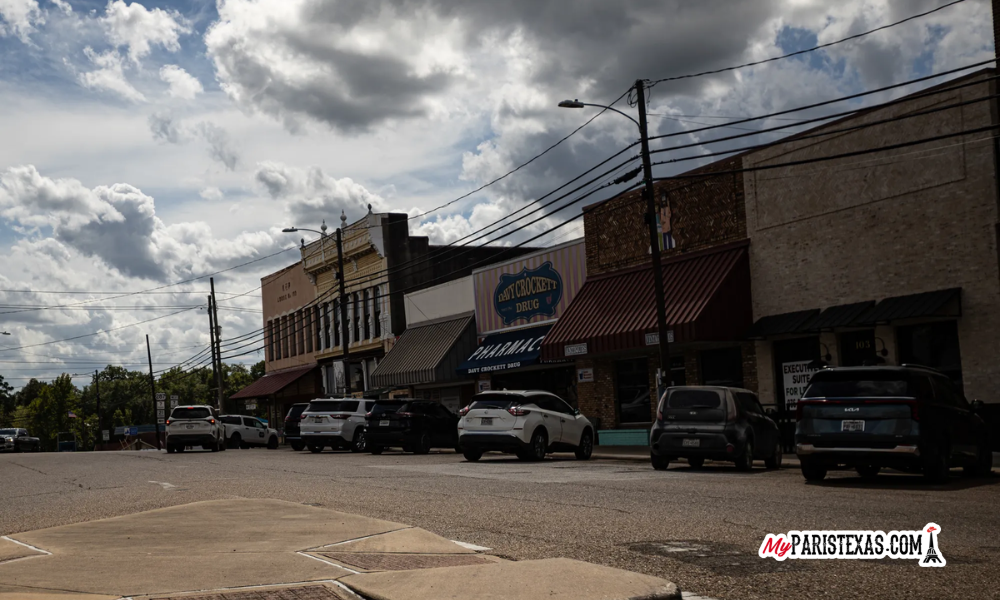
Photo: Downtown Crockett is shown on Sept. 30, 2026. Crockett is in East Texas, about 45 miles east of Lufkin. Jacob Lujan/The Texas Tribune