
Choke Canyon has almost doubled its supply of water this week, although the reservoir is still at 15% capacity.
Two critical South Texas lakes that supply water to drought-stricken Corpus Christi will rise significantly in the coming days as runoff from last week’s flooding rain flows downstream from the Hill Country.
It is, however, too early to predict if it will be a true “drought buster,” hydrological experts say, or if rising lake levels will push back mandatory water use restrictions for residents.
Corpus Christi, Texas’ eighth-largest city, has been racing to avoid a water emergency in which demand outpaces available water supplies. Earlier this year, city projections showed that “day zero” — when supplies are six months away from being outstripped by demand — could arrive as early as May. Spring rains pushed that estimate back to September 2027, but not before drawing statewide and national attention as the city appeared to be the first major U.S. city to be on track to run short of water.
For months, local leaders said the region needed either steady rain or a hurricane to replenish the largely empty reservoirs. Last week’s intense storms across Central and South Texas, which triggered flash flood emergencies, evacuations and rescues, may deliver some of the hoped-for relief.
The biggest gains, so far, have been at Choke Canyon Reservoir, the city’s largest water resource. The lake climbed from 7.9% of capacity on Monday to 19.8% by Saturday. The reservoir was last consistently full in the early 2000s and has been below 50% full since 2013.
“It’s nothing to sneeze at,” said Robert Mace, a water expert and executive director of the Meadows Center for Water and the Environment at Texas State University. He said reservoirs are still rising, signaling that more water is on the way.
Just a few months ago, the region’s outlook was far more dire. In April, the major regional reservoirs reached historic lows — Choke Canyon dropped to 7.4% of capacity while Lake Corpus Christi fell to 8.5%. That same month, at least six small cities and towns in the Coastal Bend region issued disaster declarations amid the water crisis. Corpus Christi, which supplies water to some of its neighbors, told its residents and businesses to cut their water use.
“Even if [Choke Canyon] stopped going up today, it buys Corpus valuable time to pursue alternative supplies,” Mace said.
Rainfall runoff from the Frio, Atascosa and Nueces River systems is expected to contribute vital inflows to both Choke Canyon Reservoir and Lake Corpus Christi. The capacity of Choke Canyon is three times that of Lake Corpus Christi.
Source: Alejandra Martinez,The Texas Tribune
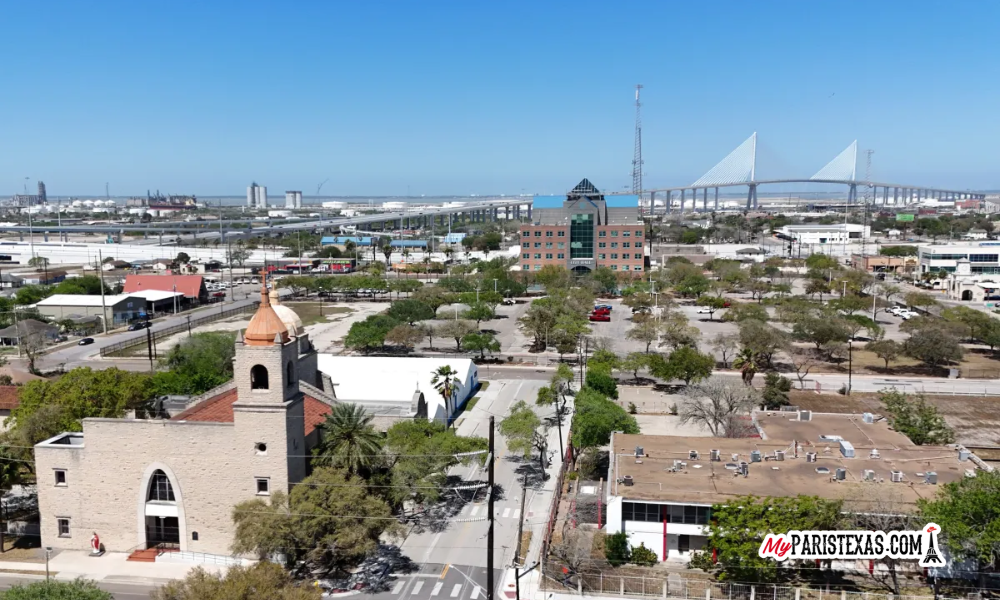
Photo Credit: The Corpus Christi skyline along the north end of downtown includes city hall and the new Harbor Bridge over the Port of Corpus Christi. Pete Garcia for The Texas Tribune
The Texas Tribune is a nonprofit, nonpartisan media organization that informs Texans — and engages with them — about public policy, politics, government and statewide issues.