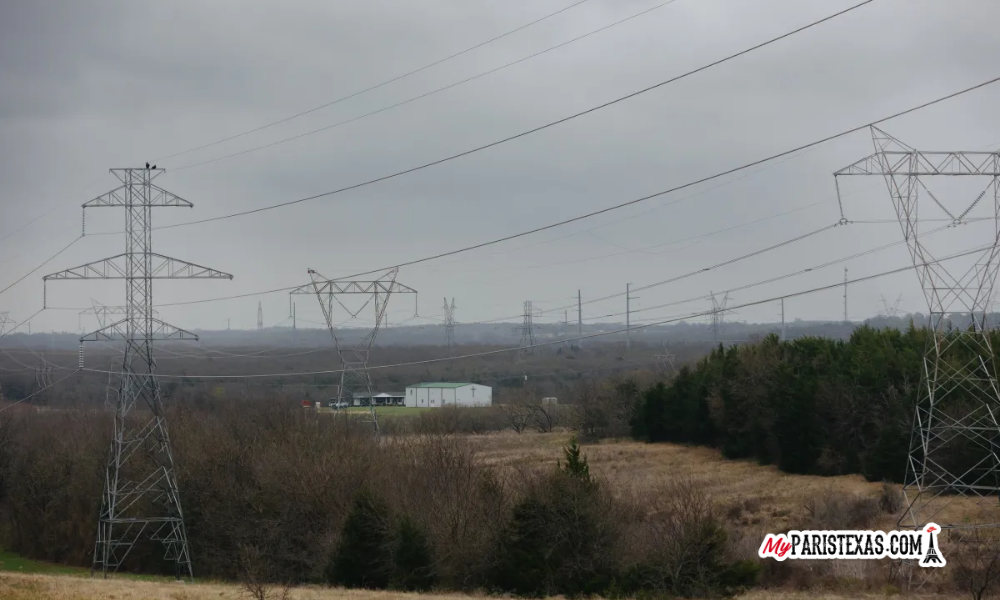

Following hours of testimony on Friday, the Public Utility Commission of Texas has approved two transmission lines to ship electricity to the oil-and gas-producing west.
ODESSA — In a move that could dramatically reshape the state’s electricity infrastructure, alleviate a years-long energy bottleneck and anger landowners, the Public Utility Commission of Texas has authorized the buildout of more than 400 miles of transmission lines to deliver electricity to the power-starved oil and gas and industrial manufacturing industries.
The five-panel commission voted unanimously to approve amendments to two Certificates of Convenience and Necessity (CCN) filed by Oncor, contrary to calls from the Texas Senate and certain House members to delay approvals until the Legislature could reform the process. Commissioners tabled a decision on the Howard Solstice transmission line, which would run through South Texas, to conduct further deliberations.
Barring successful legal challenges against the applications, it is the last administrative hurdle before the two transmission companies can break ground on the billion-dollar projects.
“I understand the proceedings are not just about infrastructure to you,” Commissioner Courtney Hjaltman told landowners at the Friday hearing. “They’re about your land. They’re about something deeply personal. They’re about your heart … and we understand that. We appreciate your participation in the process. We recognize the importance of the decision before us, and we don’t take it lightly. We have to constitutionally weigh certain factors in making our decisions, and that’s what we’re doing.”
The approval means the companies, known as transmission service providers, can begin construction on two 765-kilovolt transmission lines that will ship electricity southwest from Bosque County. The two applications span at least 30 counties.
They represent the first proposals in the Permian Basin Reliability Plan, passed by lawmakers in 2023 for the oil and gas industry, to earn regulatory approval amid a year of staunch opposition from landowners and scrutiny from the Texas Legislature. It was also in the crosshairs of a fight over a data center boom in Texas, which has raised alarms about the environment and electricity costs.
The decision came after an hours-long meeting in which landowners told commissioners the proposed transmission lines would harm their land, the surrounding natural resources and wildlife. Some testified Oncor did not give them enough time to contest their applications, an assessment the commission’s administrative court agreed with. Ultimately, commissioners sided with Oncor, saying the company satisfied the requirements of the law.
Industry leaders have said the lines are meant to support the flow of electricity in West Texas’ oil-rich region, the Permian Basin, which they said has been overcrowded with oil companies with no means of powering their operations. The manufacturing sector argued that energy forecasts for the industrial sector did not adequately reflect its growth, creating a more than a decade-long delay.
At the Friday hearing, oil and gas leaders warned that failing to approve the applications could endanger operations and risk rolling outages in West Texas.
“The fact is, America’s most important energy security region is at risk,” Todd Staples, president of the Texas Oil and Gas Association, told commissioners. “West Texas operations, West Texas homes, schools, and businesses are all threatened today because it lacks access to dependable, reliable, affordable interconnection into the ERCOT grid. This is not hypothetical or conceptual. It is real. It is tangible. It’s immediate.”
Betsy Madru, a lobbyist representing Midland-based Diamondback Energy, said the company has been generating its own power, 80 megawatts, to make up for the deficit. Diamondback gets 330 megawatts from the grid.
“We wouldn’t expect Dallas or Houston or businesses right here in Austin to generate their own power, and the Permian Basin is no different. Current wait time for business interconnection is over two years,” Madru said. “Not supporting the Permian Basin reliability plan is short-sighted at best, seeing as this industry sent $27 billion to the state last year for roads and schools. In closing, our current power situation is simply unsustainable.”
All five of the applications faced hundreds of administrative protests and interventions from landowners who said their property would fall along the route. Most feared the construction would do irreparable damage to the land, leaving scars in farmland that families have inhabited for generations. Landowners contesting the applications also said the 180-day timeframe was not enough for regulators to process every case.
At issue was whether the state’s grid managers, the Electric Reliability Council of Texas, proved that the lines are needed, an assessment regulators heavily relied on in their decision-making. Landowners said ERCOT should have looked at more options, arguing the plan should not have called for 765kV lines.
“The current state of fearmongering by the gas industry is very inconvenient because we already know that this grid reliability is not intended to help the average resident,” said Amanda Griffin, vice president of the Hill Country Preservation Coalition, which has represented thousands of landowners on this matter. “We know that it is intended to increase power to the Permian Basin … however, now this ERCOT plan is traversing the state; more than half of the Texas counties are affected by this. So rural voters are awakened. We’re aware. We’re prepared to clean house in November.”
On Friday, landowners asked commissioners to rethink some of the proposed routes.
“Our cattle and hunting business would be irreparably harmed by the installation of one of these routes. We routinely use helicopters and fixed-wing aircraft for gathering cattle, deer surveys, seeding, planting, herbicide application, and other essential tasks,” said Rocky Sullivan, owner of Two Rivers Ranch, south of Sabinal, and in Medina and Uvalde counties.
Source: Carlos Nogueras Ramos, The Texas Tribune
Photo Credit: Power lines go through a property in Bells, seen on March 10, 2026. Shelby Tauber for The Texas Tribune
The Texas Tribune is a nonprofit, nonpartisan media organization that informs Texans — and engages with them — about public policy, politics, government and statewide issues.