
Senate Republicans may be a foil. Plus, lawmakers would have to figure out how hemp, medical cannabis and recreational marijuana can coexist.
Sarah Todd, director of the Texas Cannabis Policy Center, felt confident that James Talarico would win his U.S. Senate seat on election night, but when she witnessed a complete blue wave wash over the state, she felt something else: optimism for an adult-use cannabis market in the Lone Star State.
“I’m very surprised and now very excited for this new day in Texas,” Todd said. “I think we have a very clear path to adult legalization in Texas.”
Lawmakers last week filed a slew of proposals ahead of the legislative session that starts in January, including several that would legalize, tax and regulate marijuana in Texas.
Adult-use cannabis bills have been submitted by lawmakers for the past several legislative sessions, but Republican-dominated health committees and the Senate often squashed them before they got far.
Todd said this is due to soon-to-be former Lt. Gov. Dan Patrick, who made it a priority to ban THC products last legislative session. But with new THC-friendly leadership being established in multiple state positions, the concept of legalizing marijuana has never been closer to a reality, Todd said.
“There are Republican senators who believe in cannabis law reform, and it remains to be seen what the environment in the Senate is going to be,” she said. “But I’m very hopeful and positive that we’re going to be having a lot different conversations than we’ve ever had in the past.”
If an adult-use cannabis program is approved in Texas, it will join a growing list of states that have created entire industries off a plant, but what that might mean for the current THC market in the state still needs to be figured out.
“Part of what we are working on is making sure that all stakeholders have a voice in this process,” Todd said.
The THC market in Texas
The legal THC market in Texas is almost entirely hemp-derived products sold by licensed retailers. The only legal marijuana available to the public is the Texas Compassionate Use Program, which is meant for patients who meet specific medical conditions.
Hemp and marijuana are pretty much the same thing, coming from the same plant, with the real distinction between the two being how much THC it contains when harvested.
Under the 2018 federal farm bill, hemp with no more than 0.3% delta-9 THC became legal nationwide, leading to a booming industry in Texas with farmers, distributors and stores quickly taking advantage of the rule change to sell legal high-inducing products to the public. The Texas Department of State Health Services lists about 14,000 retail stores licensed to sell consumable hemp, with the industry generating around $300 million a year in state tax revenue.
Over the past year, state rules and court rulings have narrowed the hemp market sharply, and a looming federal ban coming next month is putting more pressure on the shrinking legal THC market in Texas.
DSHS earlier this year passed new rules on the hemp industry enforcing a 0.3% total THC limit that eliminates smokable hemp, which makes up more than half of some stores’ inventory. A federal funding deal will also ban hemp-derived products with more than 0.4 milligrams of THC, criminalizing nearly all consumable hemp nationwide and effectively shutting down the $8 billion industry in Texas.
Lukas Gilkey, chief executive of Hometown Hero, a manufacturer of hemp-derived products, said industry leaders plan to speak with lawmakers to discuss market protections and clarity on their future.
Source: Texas Tribune BY Stephen Simpson
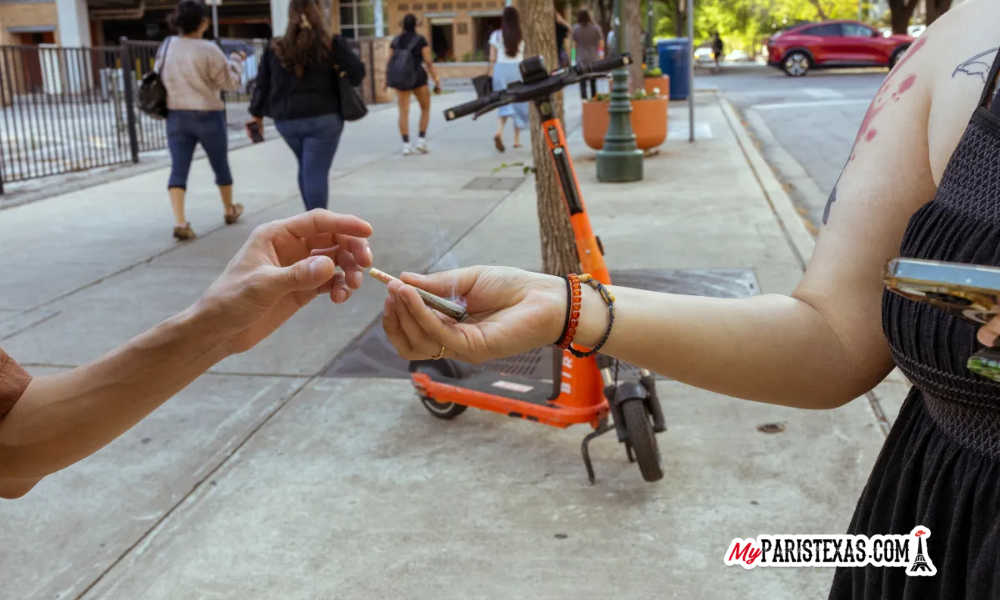
Photo: A customer smokes a rolled THC joint from Happy Clouds Smoke Shop in Austin on, March 30, 2026. Leila Saidane for The Texas Tribune