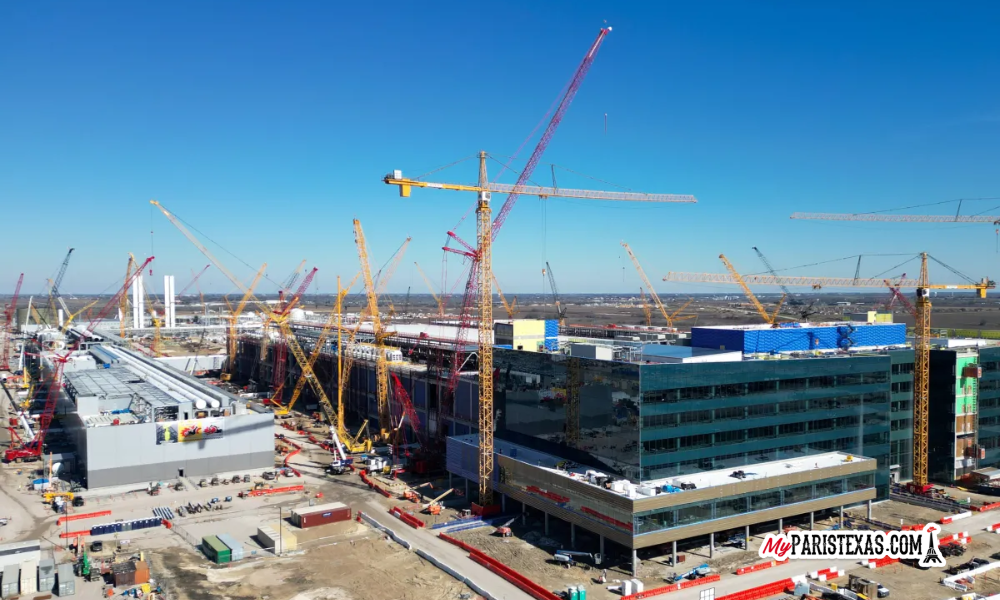

For years, the state has been the leading exporter of semiconductor chips. After the Legislature invested more than $1.5 billion into incentives since 2023, the industry has been booming.
California might have the Silicon Valley, but Texas is the silicon state.
Texas leads the nation in exports of semiconductor chips, the small pieces that form the building blocks of all modern electronics, and the industry is currently experiencing a boom.
“It seems unprecedented relative to what I have seen since I got into the business in 1998,” said Steve Putna, director of Texas A&M’s Semiconductor Institute. “I think this ecosystem has been significantly replenished as a result of all the incentive funding we’ve seen.”
Federal investment and the flurry of data centers being built in Texas and across the country have expanded the industry even more.
In recent months, a series of new or expanded semiconductor fabrication plants, or “fabs,” have begun operating or been announced in the Lone Star State, including the launch of Texas Instruments’ $40 billion semiconductor facility in Sherman late last year, Nvidia and Winstrom Corporation’s plans for two facilities in north Fort Worth and Elon Musk’s massive “Terafab” semiconductor megafacility proposed in Grimes County.
There are currently a total of 57 individual semiconductor facilities in the state, representing more than 47,000 workers across semiconductor fabrication plants, materials manufacturing and research and development, according to the Semiconductor Industry Association.
The semiconductor institute, which broke ground on a $226 million research and development facility in Bryan in April, is part of the state’s $1.5 billion Texas CHIPS Act, passed in 2023, to incentivize new semiconductor manufacturing in Texas as well as the research and workforce development that goes into it at the state’s universities. From the law, Texas A&M University received the funding for the center and the University of Texas at Austin received $440 million for its own research and development center.
State leaders used the rest — $698.3 million — to create the Texas Semiconductor Innovation Fund, which provides grants to companies seeking to build new or expand semiconductor manufacturing and design projects in the state. That fund rose to nearly $950 million after the Legislature appropriated an additional $250 million last year.
Since its creation, the fund has paid out $512.3 million in grants to 29 separate projects, totaling $9.3 billion in capital investment in Texas, according to Gov. Greg Abbott’s office. Those projects will create 2,689 direct jobs, according to the Governor’s Office.
“Texas is where the integrated circuit was born and where the future is forged,” Abbott said in a statement earlier this month, after announcing a $33.6 million grant for Texas Instruments to expand their semiconductor wafer fab in Richardson. Abbott was referencing the invention of the integrated circuit, or the earliest version of the microchip, by Texas Instruments in 1958.
A further eight innovation fund grants have been announced since the start of April across the state. A majority of the TSIF grants have gone to companies planning to operate in Central Texas, according to the Governor’s Office.
The U.S. was once the world leader in semiconductor manufacturing, producing about 40% of the world’s supply, but that share of the market has dropped to about 10% after companies sought cheaper labor overseas, primarily in Taiwan and South Korea, for the most advanced microchips.
The rapid growth of the industry is considered essential for U.S. national security by state and federal officials concerned with the nation’s dependence on foreign semiconductor manufacturing for the chips that power everyday electronics like cell phones and washing machines all the way up to the latest weapons in use by the Pentagon, Putna said.
Source: Paul Cobler, The Texas Tribune
Photo Credit: Construction continues on Samsung’s semiconductor manufacturing facility located in Taylor, on Jan. 6, 2024. Scott Coleman/ZUMA Press Wire via REUTERS
The Texas Tribune is a nonprofit, nonpartisan media organization that informs Texans — and engages with them — about public policy, politics, government and statewide issues.