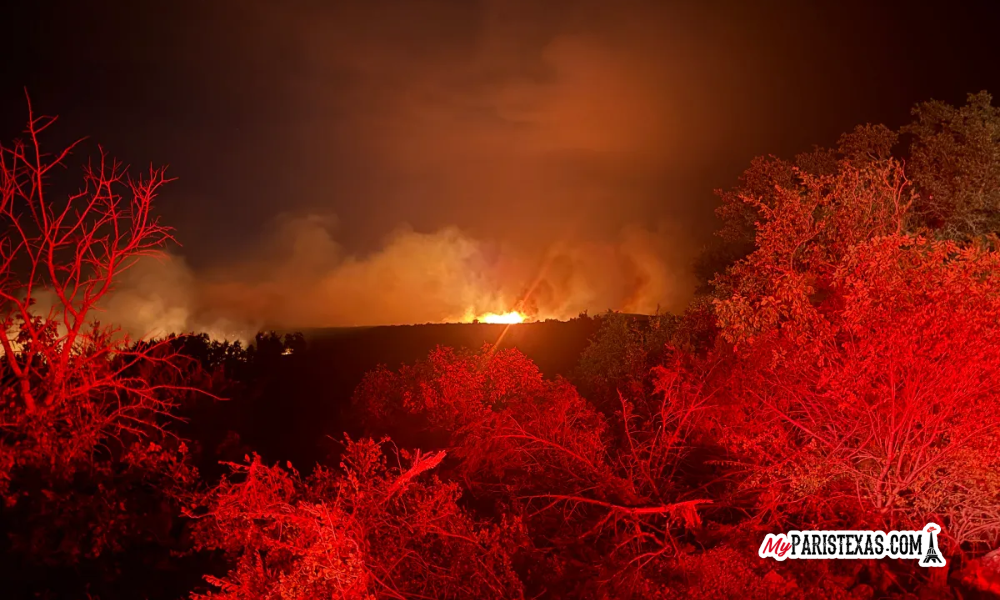

Over three days the fire has grown to more than 80,000 acres in Palo Pinto and Jack counties and is 12% contained, according to the Texas A&M Forest Service. No injuries have been reported.
FORT WORTH — The Ross Fire has grown into one of the largest wildfires in the Dallas-Fort Worth area’s recorded history, scorching more than 80,000 acres across Palo Pinto and Jack counties in just three days.
The fire, which began Monday near Palo Pinto, grew with extraordinary speed in the dry ranchland. By Tuesday, officials reported that the fire had doubled in size in a few hours to about 50,000 acres. By Wednesday, the estimate had climbed above 80,000 acres.
Firefighters have reported extreme fire behavior, including trees torching in groups amid strong winds.
There have been no reports of injuries from the fire, but some rural residents have been advised to evacuate over the past three days and officials told residents in or near affected areas to be prepared to leave quickly if conditions change.
Local officials have closed numerous roads in Palo Pinto County, including parts of U.S. 180 and Texas 254 as crews continue responding to the fire.
As of Thursday morning, the Texas A&M Forest Service said the fire remained about 12% contained, which refers to the portion of the fire’s perimeter where firefighters have established a line or barrier aimed at stopping the fire from spreading.
As much of the state experiences extreme heat, the Forest Service reports 80 active fires scorching over 90,700 acres across Texas, including the Ross Fire. Many of them are fully contained.
The Forest Service reports some structures have been impacted by the Ross fire, including Worth Ranch, a 800-acre historic Scouting America camp along the Brazos River. The extent of the property damage is unknown.
The Ross Fire is now the second-largest wildfire in the area’s history, according to the National Weather Service’s Fort Worth office, behind the Possum Kingdom Complex Fire, which burned 126,734 acres in April 2011.
The response team battling the Ross Fire includes small rural departments closest to the fire, the Texas A&M Forest Service and local fire departments around the Dallas-Fort Worth area.
The priorities are to protect people, defend communities and critical structures, slow the fire’s movement and build lines that can eventually hold the fire in place, according to The Texas A&M Forest Service.
Gov. Greg Abbott announced Tuesday that FEMA had approved a Fire Management Assistance Grant for the Ross Fire, which gives local agencies financial help and reimburses eligible firefighting costs.
Portions of Jack County were ordered evacuated Tuesday as the fire moved north. That order was later lifted as conditions improved, but officials have continued warning residents to remain vigilant. Palo Pinto County had issued voluntary evacuation advisories for areas threatened by the fire, but those notices have been lifted as well.
Source: Alejandra Martinez, The Texas Tribune
Photo Credit: The Ross fire started in Palo Pinto County on Aug. 24, 2026 and has since grown to more than 80,000 acres across Palo Pinto and Jack counties. A. Turner/Texas A&M AgriLife
The Texas Tribune is a nonprofit, nonpartisan media organization that informs Texans — and engages with them — about public policy, politics, government and statewide issues.