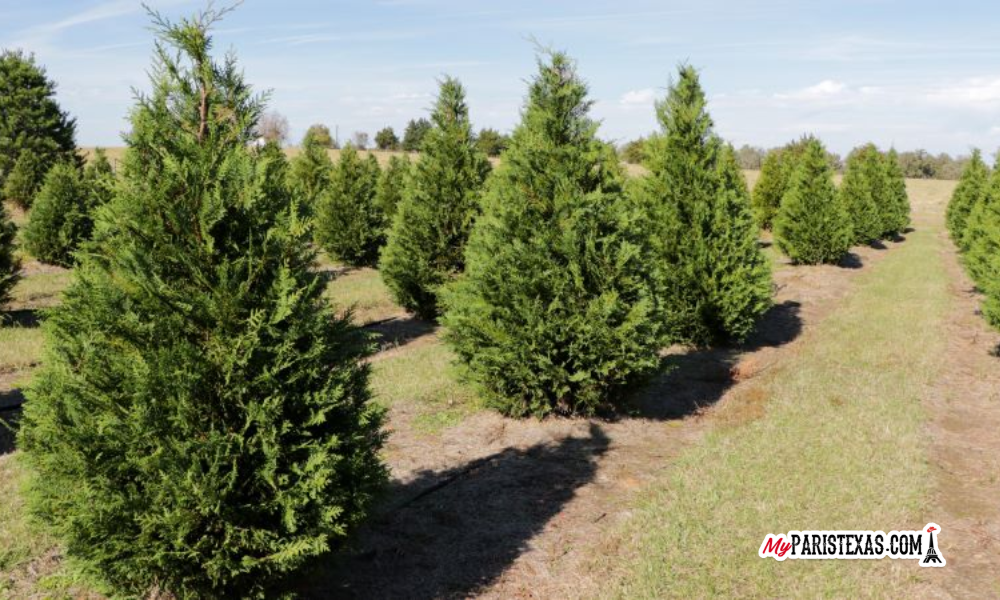

More than four million real Christmas trees are purchased annually in Texas, an important contributor to the Texas economy.
Texas A&M Forest Service recently conducted an economic study which revealed the Texas Christmas tree industry generated total economic contribution of $812.7 million, including direct, indirect and induced effects, while supporting 6,217 jobs in 2024.
“Real Christmas trees hold cultural, environmental and economic significance, but the scope of this study was focused specifically on the economic contribution of the real Christmas tree industry,” said Xufang Zhang, Ph.D., Texas A&M Forest Service Forest Resource Analyst.
Of the $812.7 million in total contributions, the Texas Christmas tree industry had a direct economic contribution of $430.0 million, employing 4,228 people with a payroll of $278.6 million.
The industry also contributed $2.2 million in county taxes, $13.4 million in state taxes and $82.8 million in federal taxes, totaling a tax revenue of $98.4 million.
Texas Christmas tree farms
Since the 2023 report, direct contributions to the economy have increased by over $32.8 million, an increase not possible without sustainable practices and a continued increase in land use for Christmas trees.
According to the USDA National Agricultural Statistics Service, Christmas tree production acreage in Texas has increased substantially from 945 acres in 2017 to 3,565 acres in 2022.
“The increase in land area used for Christmas tree production and the increasing number of choose-and-cut farms highlights the industry’s potential for continued economic contribution,” said Zhang. “These findings underscore the importance of sustainable industry practices, investment in local production and policies that strengthen rural economies.”
According to the National Christmas Tree Association, the most popular Christmas tree species include Fraser fir, Noble fir, Douglas fir, Balsam fir, Scots pine, Virginia pine and White pine. For every Christmas tree harvested, one to three seedlings are planted the next year. The average Christmas tree takes about seven years to reach maturity.
Benefits of real Christmas trees
There are many benefits of purchasing a real Christmas tree over an artificial one that go beyond helping the Texas economy.
Artificial Christmas trees are a petroleum-based product, containing plastics that are not biodegradable and may contain metal toxins such as lead which create a long-term environmental burden upon their disposal.
Like any other tree though, Christmas trees growing on tree farms reduce soil erosion, improve water quality, provide habitat for wildlife, create scenic beauty and recreational opportunities, sequester carbon, emit oxygen and are renewable and compostable.
Article source and photo credit: Texas A&M Forestry Service