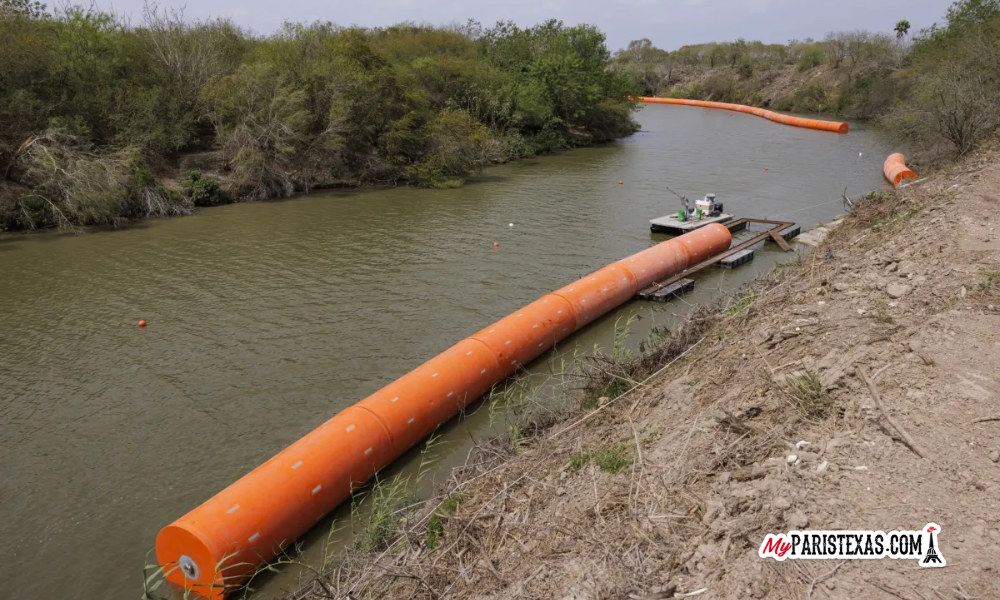

The government is installing the first 17 miles of industrial-grade buoys in Brownsville. Experts warn the buoys could intensify flooding and change the river’s course.
An experiment unfolding at the southernmost tip of the state could irrevocably change the iconic Rio Grande and the communities it sustains.
Contractors are installing a 17-mile stretch of cylindrical buoys in the river to prevent illegal crossings from Mexico. These are the first of 536 miles of buoys that the federal government plans to stretch from the Gulf of Mexico deep into South Texas. The Department of Homeland Security has waived environmental laws and issued more than $1 billion in contracts to private companies to install them in continuous chains. Each industrial-style buoy is more than 12 feet long and four to five feet in diameter.
Federal agencies have not made any environmental assessment or flood modeling for the border buoys available to the public. Experts have criticized the secrecy surrounding the project and warn that the buoys could intensify flooding and change the river channel.
Mark Tompkins, a geomorphologist who studies the flow of rivers and conducted an analysis of the buoys for a group opposed to their use, said the lack of public documentation violates the “basic professional standard of care” for projects of this magnitude. The city manager in Laredo, one community where the buoys are planned, said the city is working to obtain engineering and design information from federal agencies.
Experts consulted by Inside Climate News said they knew of no comparable undertaking on a dynamic river anywhere in the world. They warned that the buoys could speed up flood water in a region that already struggles with flooding. The buoys could also accumulate sediment and create new landforms in the river, provoking treaty disputes with neighboring Mexico. The buoys are planned through Cameron, Hidalgo, Starr, Zapata, Webb, Maverick and Val Verde counties.
“The design requirements for these barriers, set by CBP and implemented by contractors, mandate that they withstand a 100-year flood event — consistent with CBP established design standards,” a Customs and Border Protection(CBP) spokesperson told Inside Climate News. “Additionally, the barriers are engineered to endure increased currents and elevated water levels, ensuring operational reliability during extreme weather conditions.”
The spokesperson declined to provide any technical information about the design standards.
“This is an experiment on a continental scale,” said Elsa Hull, an environmental advocate and resident of Zapata County, near the buoy’s proposed path. “None of this is based on common sense or science.”
The buoys will also reduce access for boating, fishing and other recreation.
While local opposition grows, day by day, more buoys line the river.
Trump administration expands what Texas started
During the first Trump administration, in 2020, the U.S. Army Corps of Engineers sought solicitations for a “buoy barrier system.” That year the Border Patrol Academy posted, and later deleted, photos of a “buoy barrier demonstration” by the Virginia-based company Cochrane USA. The Army Corps of Engineers referred questions for this story to CBP.
The idea wasn’t implemented before Trump left office. But it resurfaced in July 2023, when the state of Texas installed 1,000 feet of buoys in the Rio Grande at Eagle Pass. The buoys provoked a diplomatic dispute with Mexico and a lawsuit from the federal government.
Unlike the buoys the federal government is now installing, the ones in Eagle Pass were spherical and segmented with saw blades. At least one person was found dead, trapped in the buoys. Advocates warned that the buoys made the dangerous trip across the Rio Grande even more deadly for migrants.
Across the entire Texas-Mexico border, more than 1,100 people died attempting to cross the Rio Grande between 2017 and 2023, according to a Washington Post investigation.
Despite the controversy in Eagle Pass, the Department of Homeland Security hatched a massive buoy project once Trump returned to office in 2025.
On July 3, Homeland Security Secretary Kristi Noem waived more than 30 federal laws in a 20-mile area along the Rio Grande in Cameron County to expedite the Waterborne Barrier Project’s first federal border buoys. Among those laws: the National Environmental Policy Act, the Endangered Species Act, the Migratory Bird Conservation Act and the Safe Drinking Water Act.
“A capability gap has been identified in waterways along the Southwest border where drug smuggling, human trafficking and other dangerous and illegal activity occurs,” Noem wrote.
In October, Homeland Security waived contracting and procurement laws along the entirety of the U.S.-Mexico border to speed up construction. Since then, billions of dollars have been awarded to private contractors from the One Big Beautiful Bill Act for border fortifications.
The unprecedented expenditure comes as the number of unauthorized border crossings has dropped precipitously. CBP apprehended 73% fewer people in the Rio Grande Valley sector between fiscal years 2024 and 2025, according to agency data.
Noem traveled to Brownsville on Jan. 7 to announce the first buoys. CBP granted access to the conservative news outlet Washington Examiner to see the buoys installed. Border Patrol Chief Michael Banks explained to the reporter that the buoys are designed to roll when someone tries to climb on them.
“It prevents them from ever being able to climb up on it,” he told a reporter. He added that the buoys have been tested in pools with dive teams.
President Donald Trump announced on March 5 that he was replacing Noem as homeland security secretary; she leaves the position on March 31.
Unlike the Eagle Pass buoys, the new buoys are much larger, cylindrical and form a continuous barrier across the river.
BCCG Joint Venture was awarded a $96 million contract for the first 17-mile section of buoys in Brownsville. At a cost of $5.6 million per mile, the whole project would top $3 billion.
Inside Climate News reviewed federal contracts and identified seven along the Texas-Mexico border, totaling over $2.5 billion, that reference either “waterborne barriers” or “waterborne buoys.” Three contracts that referred exclusively to buoys and waterborne barriers totalled $1.22 billion. Another four contracts worth a total of $1.33 billion referenced both buoys and border wall construction.
Cochrane USA was awarded $641 million for “waterborne barrier construction.”
Tucson-based Spencer Construction LLC has obtained four contracts totaling $1.21 billion. Fisher Sand and Gravel, which built border walls later embroiled in legal challenges, was awarded a $316.7 million contract. SLS Federal Services LLC was awarded $382.3 million for waterborne and “vertical” barriers.
The federal waivers have allowed this unprecedented project to proceed with little scrutiny.
“The laws that have been waived were put in place specifically to protect communities from improperly built structures like the wall,” said Ricardo de Anda, a lawyer in Laredo whose property abuts the river. “The Environmental Policy Act would not have allowed the construction of these structures because they would damage the environment.”
The buoys are planned through the Laredo area, which to date does not have a physical border wall.
“The fact that they have waived these laws means they are creating a law-free zone along the border,” de Anda said. “The problem for the country is that if people become comfortable with that … then it’s coming your way.”
“Potentially catastrophic”
In Laredo, landowners and local advocates successfully opposed border wall construction during the first Trump administration. Now, old networks are reconnecting to oppose both renewed efforts to build the wall and the buoys.
“There has been no comprehensive information from the feds,” said Tricia Cortez, executive director of the Rio Grande International Study Center in Laredo. “People need to be aware of this quiet, under the radar, but very aggressive move that the federal government is directing on us at the border.”
The organization decided to commission Tompkins, a geomorphologist with the consulting firm FlowWest, to conduct his own study on the potential impacts of the buoys.
Tompkins presented his findings to Laredo’s Rio Grande Riverfront Coordination Ad-hoc Advisory Committee on March 12. He warned that because of the federal waivers there is “a nearly complete lack” of technical information for the buoys.
Source: Martha Pskowski,
Photo Credit: Buoy barriers are installed in the Rio Grande in Brownsville on March 6, 2026. Michael Gonzalez for Inside Climate News
The Texas Tribune is a nonprofit, nonpartisan media organization that informs Texans — and engages with them — about public policy, politics, government and statewide issues.