
More Texans have become food insecure due to a rise in natural disasters and less qualifying for SNAP benefits. Rural food banks in particular face additional pressures.
HOUSTON — When West Houston Assistance Ministries’ food pantry flooded around Easter, pantry manager Verita Duncan, knew it couldn’t stay closed for long. Within days, around 200 families were waiting for registration to reopen, prompting the food pantry to turn to local college students for help getting back on its feet.
“We decided to open back up the next Monday, and we had 50 families waiting for us that first day, and that is a small fraction of the need,” Duncan said.
The West Houston food pantry is one of hundreds of organizations facing increased demand for food while struggling with dwindling supplies due to federal cuts. Food banks in rural counties are even more vulnerable because they depend heavily on federal funding.
“Many of the smaller pantries are not able to take care of all those families,” Duncan said.
Earlier this year, Feeding America, the national network of food banks, released its 2026 Map the Meal Gap study, which uses 2024 data. The study found that 19.4% of Texans, or nearly 1 in 5, are experiencing food insecurity, and 1 in 4 Texas children are experiencing food insecurity, representing 26.1%, or nearly 2 million children.
Food insecurity means a household lacks enough money or resources to reliably access adequate food.
Potter County, home to Amarillo, has roughly 1 in 4 residents who are food insecure, with child food insecurity at 30.7% — one of the highest child rates found in this research. The Rio Grande Valley and Corpus Christi areas had food insecurity rates over 20%.
In the Houston Food Bank’s 18-county service area, which spans from Trinity to Brazoria counties and Robertson to Chambers counties, 18% of residents — roughly 1.44 million people — were food insecure in 2024, and food bank leaders say that number is on the rise.
Food insecurity in Dallas-Fort Worth climbed to 1.4 million people in 2024, with 36% of children in the region facing hunger.
Data from the Central Texas Food Bank also revealed that 1 out of every 5 families in the nine northern counties of its 21-county service territory — Bell, Coryell, Falls, Freestone, Lampasas, Limestone, Mills, McLennan and San Saba — experience food insecurity.
Texas’ safety net for food insecurity is supported by federal nutrition assistance programs such as the Supplemental Nutrition Assistance Program, food banks and school programs.
A food bank is a regional nonprofit that sources, stores and distributes food to local programs in the communities it serves, including pantries, school programs and more, making it the backbone of the hunger-relief system. Twenty food banks serve over 4 million Texans annually through a network of more than 4,000 partners.
“We’ve definitely seen that the utilization of these programs has increased at school-based programs or school districts themselves, and many of those schools are letting us know that many, many more families are seeking assistance,” said Melanie McGuire, senior director of programs at the Houston Food Bank.
However, the food bank system is not meant to address all food insecurity in the state because most of its resources come from philanthropy, but that is exactly what is starting to happen as federal assistance declines.
From February to June 2026, calls to 211 seeking food assistance increased 28.6%, while referrals to food banks and food pantries rose nearly 37%, from 4,230 to 5,785 referrals, according to data from United Ways of Texas.
The Map the Meal Gap study reveals that a significant portion of individuals experiencing food insecurity may not qualify for federal nutrition assistance programs, such as the Supplemental Nutrition Assistance Program, or SNAP. Families not eligible for federal assistance must rely on local food banks and community meal programs to get by, placing a heavy burden on an already strained system.
“Every one of those households has a food-budget hole now, and some share of them arrive at a pantry,” said Celia Cole, CEO of Feeding Texas, the statewide network of food banks.
Texas food banks currently distribute more than 700 million pounds of food annually through a network of more than 5,000 community partners. Yet for every meal provided by food banks, SNAP provides nine.
“SNAP operates at a scale that can’t be replaced with our kind of food assistance,” said Cole.
Officials across all food bank networks are now wondering how it can continue without additional federal or state assistance.
The cost of federal cuts
In 2025, the U.S. Department of Agriculture canceled two programs that supplied $1 billion in products directly to food bank warehouses. The USDA justified the decision, saying the Biden administration had created “unsustainable” expectations by spending beyond what was standard.
The drop in federal commodities has been drastic for Texas food banks.
Cole said the food bank network absorbed $88.4 million in federal funding reductions and received 40% less in federal commodities.
The Central Texas Food Bank lost $5.5 million in funding for food purchasing. The Houston Food Bank’s total projected federal funding cuts topped $32 million.
ole said food banks now have to reduce supplies to food pantries and other community programs to cope with cuts in commodities and funding. She said rural food banks are even more exposed because they depended heavily on federal commodities and have thinner local donor bases.
“Food banks are rationing precisely so they don’t run out,” Cole said. “That could mean cutting distribution days and placing stricter limits on how often a family can visit a pantry.”
Cole said, for example, a family that could come to the food bank or another program twice a month might only be able to come once a month, leaving some families to spend days and nights hungry because there is nowhere else to turn.
The San Antonio Food Bank and Central Texas Food Bank have had to ration their food supply, and the Houston Food Bank had to reduce its workforce by 15% to offset federal funding cuts. El Pasoans Fighting Hunger Food Bank announced last year that 20% of its agency partners and 20% of its mobile pantries will no longer receive food from it.
The cuts to federal commodities have come at the same time that food banks are dealing not only with increasing food insecurity around the state, but also with more disasters that have drained resources quickly.
San Antonio Food Bank president and CEO Eric Cooper told Grist, a nonprofit climate news organization, he was concerned that food banks couldn’t meet emergency demand after the July 2025 Central Texas floods.
“Prior to this disaster, we just don’t have the volume of food in our warehouse that we need to have,” he said. “We have had to try to pivot a little bit to ration some of what we do have across the population we serve so that we can stretch [our supply].”
Rationing has a downstream impact on school programs, like food pantries and after-school programs, as many of their resources come from the same food banks.
To make up for the loss of federal commodities and funding, food banks must purchase groceries out of pocket to meet demand.
“It’s cutting into core operations,” Cole said. “It’s causing us to spend more money to get food in and out of the door.”
Food banks get their funding from donors, cities, counties or corporations, but during economic downturns, donations can drop just as demand reaches its highest. The High Plains Food Bank reported earlier this year a decrease in donated food, particularly shelf-stable items such as canned goods and box meals, the items most in demand.
“We have about eight churches that support us, so we let them know we are going to have to tap into the parishioners because the budgets are being cut,” Duncan said, admitting other food banks might not have the same type of support.
At the same time, cities and counties that provide assistance to food banks are struggling with increasing financial difficulties, forcing them to take a hard look at support for these organizations.
Austin is already considering reducing or eliminating three food programs that support college food pantries, home delivery services for seniors and food distribution to more than 90 partner organizations across the city because of financial concerns.
McGuire said one uncomfortable reality is that food banks can never meet demand for food insecurity, but they have stretched resources as best as possible. She said that with resources dwindling, food banks will have to find different ways to address food insecurity in Texas.
Source: Stephen Simpson, The Texas Tribune
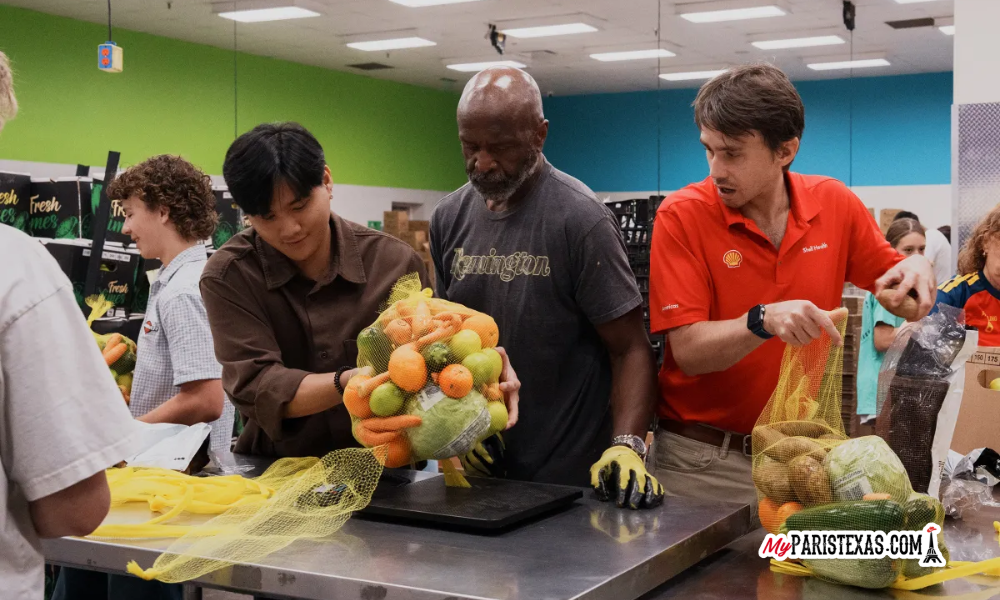
Photo Credit: Volunteers and a group participating from Shell’s health program sort and prepare food at Houston Food Bank in Houston on Aug. 12, 2026. Hope Mora for The Texas Tribune
The Texas Tribune is a nonprofit, nonpartisan media organization that informs Texans — and engages with them — about public policy, politics, government and statewide issues.