
Young and newly planted trees need particular care and attention to increase their chance of survival. Especially in the cold.
Though Texas is not known for harsh winters, the winter season can still be tough on trees as evidenced by Winter Storm Uri in February 2021. Harsh conditions like cold winds, bright sun, bitter ice, snow and frost can be damaging and add stress to trees.
Protect young or newly planted trees from winter damage
Watering
Newly planted trees don’t have extensive, well-established root systems, meaning they are usually shallower and not able to use soil moisture as effectively as more mature, healthy trees.
Water helps insulate both the tree and the soil. Moist soil will be warmer, and a well-watered tree will be less susceptible to freeze damage. If a hard freeze is forecasted and soil moisture is low, it is best to water the tree before freezing temperatures occur.
Recommended watering schedules vary by region but, in general, should be followed through October and early November. For hardwood species that go dormant, watering can be reduced to once or twice per month, depending on rainfall, in winter months. Watering should be done early in the day, so the tree has time to absorb it before the drop in nighttime temperature.
Mulching
Mulch is a simple and inexpensive way to winterize a young or newly planted tree. In addition to providing a barrier of protection against wind, freezing temperatures, and frost, mulching helps trees retain heat from the soil.
Repeated freezing and thawing of the soil can cause soil to expand and contract, which in turn can cause root damage. Mulch acts as an insulator preventing cold air from penetrating the root zone of newly planted trees and keeping soil temperatures higher, which helps to keep the trees warmer during the winter.
A two- to three-inch layer of mulch should be spread around the base of the tree, at least the width of the root ball on a newly planted tree taking care to keep the mulch about two inches away from the tree’s trunk.
Wrapping
The sun can be quite damaging to a young or thin-barked tree on a cold winter day by heating up the tree’s bark, stimulating activity. When this happens and then passing clouds drift by, blocking the sun, bark temperature can drop rapidly, damaging or killing that active tissue. The resulting damage is called sunscald.
Sunscald can be avoided in these vulnerable trees by wrapping the trunk for winter protection. Wrap the bark of susceptible trees in late fall with either tree wrap tape, plastic tree guards or similar light-colored material. These can be found in garden stores.
Remove the wrap in the spring after the last frost to avoid insects living under the material during the summer.
Pruning
Winter, or the dormant season, is the best time to prune trees. Especially young or newly planted trees that may require some pruning to train growth away from conflicts.
Most light pruning or pruning that removes dead, damaged, weak or diseased limbs can be done at any time during the year with little effect on the tree, but if live tissue is to be removed it is best to wait until mid- to late winter.
Generally, wound closure is maximized if pruning takes place before the flush of spring growth. Heavy pruning of live tissue just after the spring flush should be avoided, especially on weak or stressed trees.
Ice damage and oak wilt
If your oak trees are damaged in a winter storm, keep in mind protecting them from oak wilt.
While painting fresh wounds on oak trees is important to prevent the spread of oak wilt, wounds that were caused by the ice storm are no longer fresh. In cold conditions, trees quickly stop exuding sap and sap-feeding beetles are not active, so it is unlikely that oak wilt will spread as a result of an initial ice storm event.
Prune safely within your ability and DO NOT remove limbs on or near power lines. For work you cannot complete safely or that is beyond your ability, find a Certified arborist. Be sure to immediately paint any new wounds on oak trees that are created during cleanup using wound dressing or latex paint.
Immediately means make one cut then paint it before making the next cut. Clean all pruning tools with a 10% bleach solution or Lysol ™ before pruning a different tree.
Additional cosmetic pruning of oaks should be delayed until summer, once the threat of oak wilt spread has diminished. Avoid pruning oaks from February through June. Any trees that are not oaks can be pruned at any time and painting the wounds is not necessary.
When disposing of debris, burning should be delayed until spring green-up when wildfire danger is reduced. If debris must be disposed of immediately, a chipper is recommended Prevent Wildfire.
Most live oaks, and many other trees that currently have leaves, may also have suffered freeze damage. However, it is difficult to determine the true extent of this damage until after spring green-up. Trees are quite resilient and the damage may not be as bad is it initially seems.
So be patient, prune selectively and be sure to paint any fresh wounds on all oak trees.
Ice Damaged Pines
When there is an ice storm or sudden freeze, your property’s trees might be adversely affected.
The most common form of damage is branch loss. The sudden additional weight of snow or ice can be enough to cause weaker limbs or sometimes the entire tops of trees to snap off and fall.
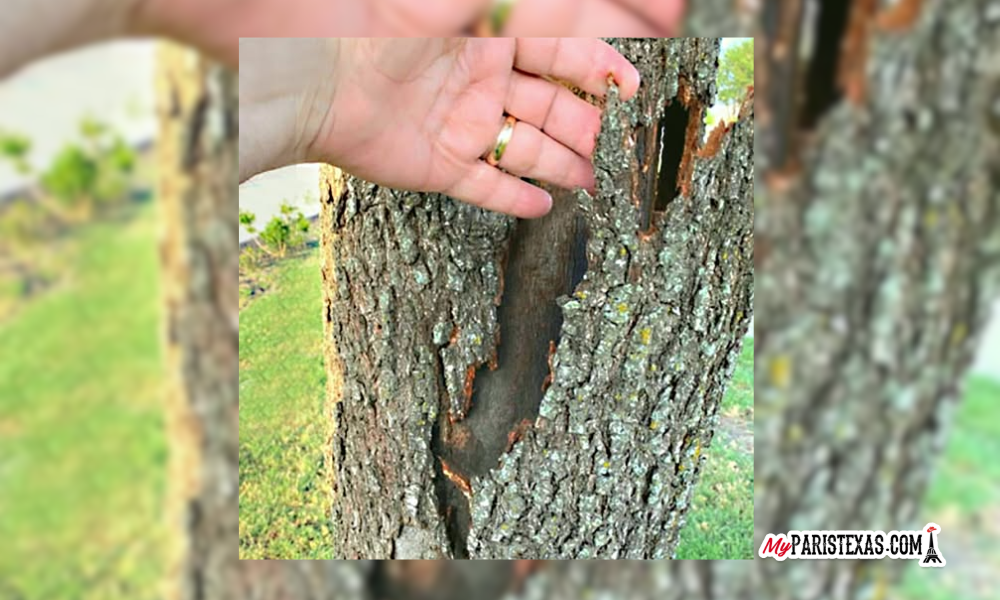
If a freeze occurs early in the fall or late in the spring, it can cause the fluids moving within the vessels of the tree’s leaves and limbs to freeze, expand, and even burst. Resulting in wilted leaves, dead limbs, and potentially even cracks in the bark.
Trees that are significantly damaged by winter storms will have weakened immune systems as they use their resources to try and repair the associated damage. This added stress can leave a tree open to attack by secondary pests and diseases.
Additionally, the open wounds left behind from snapped branches can provide an easy opening that many pest species will take advantage of.
Secondary pests to ice damaged pines could include pine beetles and more.
Pine beetles
Pine bark beetles, also referred to as engraver beetles or IPS, as well as black turpentine beetles are both very common species in Texas. Under normal circumstances, they pose little threat to your pines. However, trees that are weakened by ice storm damage are more at-risk to being attacked by engraver beetles.
Pine trees with large breaks on the trunk below their branches or a severe bend from excessive weight are probably in severe distress, as are those with four or less large branches remaining are also particularly vulnerable.
Southern pine beetles (SPB) are another species of beetle infamous for their impact on tree farms and natural forests alike. Much like pine bark beetles and turpentine beetles, they generally attack weakened or distressed pines at low population levels but can quickly spread to and kill perfectly healthy trees as an infestation develops. Thankfully, there have been no reported SPB cases in Texas since 1998, and we take special care to monitor for their return.
Generally, the risk of pine beetles reaching epidemic proportions after a winter storm or freeze is very low. Insect activity is significantly reduced in temperatures below 50° Fahrenheit. Once conditions improve, pine beetles will likely begin to attack some of your dead or dying trees, but much of the timber will spoil and become undesirable before it can be infested, and neither engraver nor turpentine beetles will have any interest in the remaining, healthy pines.
It is still recommended that host trees, those highly infested, be salvaged (removed) from a stand/property, when possible, to reduce the risk of the beetles spreading to other adjacent trees.
Other pests
There are many other pests that can attack not only your pines, but hardwoods too. These can include fungi like root rot, oak wilt, or hypoxylon canker, which are more likely to attack trees with open wounds and cause serious damage to or even kill particularly stressed trees.
These pathogens are present in Texas forests and neighborhoods regardless of the current conditions. But they require extenuating circumstances before they’re able to kill a tree.
A tree infested by fungi will likely develop structural weaknesses as its roots and/or heartwood are eaten away, which can pose a hazard especially if the tree is in proximity to structures. It’s unlikely though that a tree will immediately die in the event of an infestation by almost any single species of pest. It may even take years.
Use our Tree MD tool to determine what pests might be impacting your trees. But before you make any permanent management decisions, contact your local forester.
Treatment
Trees that have experienced limb loss still have a high chance of recovery. The primary consideration is the extent of limb loss. If a damaged tree loses half or more of its canopy over the course of a winter storm, it is significantly less likely to recover, and you should consider having the tree removed.
A common benchmark for pines is if only three or four large limbs remain, the tree will most likely die. Significant breakage on the trunk of a tree will also likely result in its mortality.
Both hardwoods and pines that have experienced only minor limb loss or some cracking on its branches or trunk will likely recover without human intervention. Under normal circumstances, trees possess a large amount of stored energy that they can use in the growing season to sprout new branches and leaves. Even in the case of a tree that suffered serious damage, giving it a few years may be worthwhile because it may still survive.
The only economical treatment for a tree whose structural integrity is compromised, either through storm damage or fungal decay, is outright removal. Structurally unsafe trees can pose serious risks to you and your home and can be a liability concern.
Treating broken limbs is also rarely necessary, as trees are generally capable of repairing themselves, given enough time and stored energy. If you’re concerned about a tree on your property, contact your local forester, or a certified arborist. You can also use My Land Management Connector to identify vendors within your area that may be able to assist you with consulting or performing practical management.
For trees that have special emotional or spiritual significance, there are more strenuous management options like fungicides or pesticides that might be applied to treat for certain diseases or infestations, and ways to improve a tree’s ability to heal over wounds left behind by snapped limbs. However, these treatments are often expensive and may not succeed in saving your tree.
If you lose an important tree on your property from storm damage, or your home is damaged from falling woody debris, you should consider consulting your home insurance provider. You may be entitled to compensation in some form.
Article source and photo credit: Texas A&M Forest Service