
Education bills filed ahead of next year’s session include those that failed in a GOP-controlled Legislature. Democrats now have the House, but the Senate retained a Republican majority.
Texas Democratic lawmakers want to tackle the substantial financial shortfalls facing public schools by investing more, with ideas ranging from bumps in student allotments to fundamentally overhauling how districts are funded.
Proposed education bills filed so far for the legislative session that starts in January include repealing the state’s $1 billion school voucher program, reforming state takeovers of districts and implementing universal pre-K for 4-year-olds.
After sweeping wins in the midterms that give them control of the Texas House and statewide offices, they say the priorities they’ve unsuccessfully pushed without much progress for years now have a higher likelihood of becoming law.
“It’s not as if the change in leadership means that we have a change in priorities. These are things that folks have been filing for quite some time,” said Rep. Diego Bernal, the vice-chair of the House Education Committee. “Now, maybe there’s more runway to have even a conversation about them, where in the past they were, for the most part, DOA.”
While lawmakers say they’re optimistic about many of their proposals, they could face resistance in the Senate, where the GOP still holds the majority. Republicans Donna Campbell, chair of the Senate Education Committee, and vice chair Paul Bettencourt did not respond to requests for comment about their priorities.
Public schools are on track to see the largest student enrollment decline in recorded Texas history this year, due largely to declining birth rates, fewer immigrants and students opting for home schooling and private schools through the state’s voucher program. Fewer students means less funding for more than 1,200 districts and charters.
Many districts are closing campuses and face steep budget shortfalls. Some school leaders are cutting staff bonuses or planned raises after voters rejected more than $6 billion in bond proposals that would have funded repairs to or replacements of aging campuses, school buses and technology.
Democrats Gov.-elect Gina Hinojosa, Lt. Gov.-elect Vikki Goodwin, and state Rep. Senfronia Thompson, the presumptive incoming speaker of the House, have not announced formal legislative priorities for public education. Texas’ three top legislative leaders typically do not announce their official priorities until after the beginning of the year.
Representatives for the leaders did not respond to requests for comment on their priorities. Both Hinojosa and Goodwin, who will oversee the Texas Senate, campaigned on reducing standardized testing, ending education savings accounts, stopping state takeovers, and increasing school funding and teacher pay.
More money for Texas schools
Texas funds schools based on a complex combination of formulas that are largely based on how many students show up for class and students’ specialized needs. Last session, lawmakers approved billions of new dollars for schools that many public education advocates said didn’t cover the cost of inflation since the last school finance overhaul in 2019.
Still, administrators say they are struggling to cover costs, including in complying with multiple unfunded mandates from the Legislature, such as requirements for school buses to have three-point seat belts or for all campuses to have an armed security officer.
More than 180 traditional public and charter campuses across Texas — including in Austin, Fort Worth and Houston — have closed since 2023, according to an analysis from Our Schools Our Democracy.
Increasing the per-student amount of money that schools receive from state and local sources, known as the basic allotment, has backing from several lawmakers, some of whom want to tie it to inflation.
The current allotment is $6,215 per student, which the Legislature increased by $55 last year. Chandra Villanueva, the senior director of policy for Every Texan, said the allotment would need to be increased to more than $8,000 per student to adjust for inflation since the last major increase in 2019.
However, a monumental shift in how schools get money would be moving from attendance-based funding to enrollment-based. Texas is one of five states using the attendance model, which includes one state that uses a combination of the two, according to a 2026 national analysis.
As a legislator, Hinojosa previously filed several bills to shift the state to enrollment-based funding, but it’s unclear if she’ll push for the move in the upcoming session. State data shows that chronic absenteeism surged during the pandemic and has remained high since, particularly among districts with more low-income students.
School budgets are unpredictable when dependent on kids showing up for class, say supporters of changing the system. Enrollment-based funding would increase funding for districts and provide predictability, they said.
“The way we’ve done it is archaic and not appropriate for how we should be funding our schools because a kid misses a day, that doesn’t change how much you have to pay for electricity,” said Rep. John Bucy, an Austin Democrat who filed legislation to shift to the enrollment model. “It just makes no sense that that is how we’ve done funding.”
Chloe Latham Sikes, the director of policy, advocacy and community engagement for the Intercultural Development Research Association, said “investing in students’ futures cannot be done” without fair school funding, including an increase to the basic allotment and shifting to enrollment-based funding.
Source: Texas Tribune BY Megan Menchaca
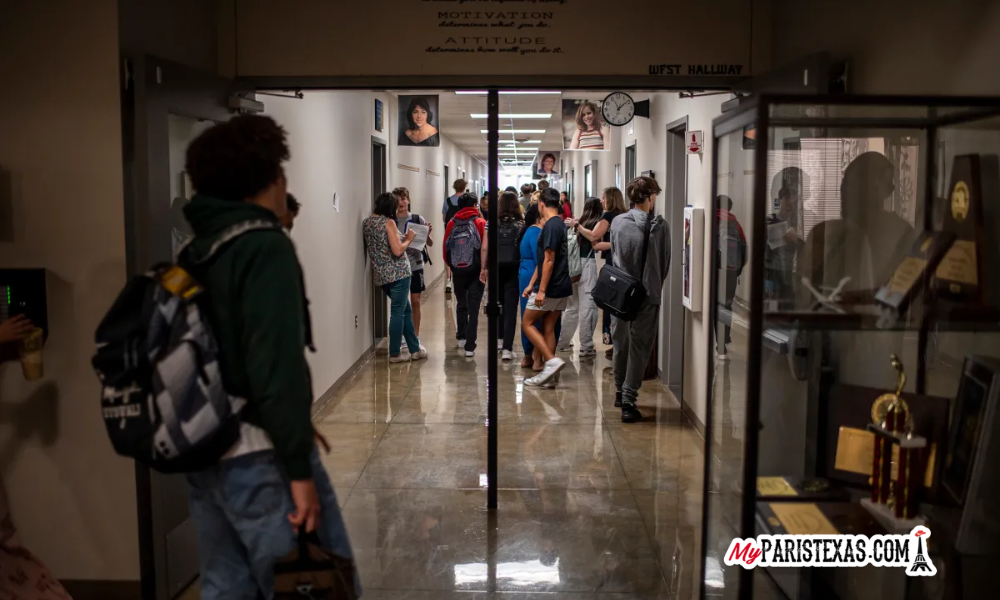
Photo: Students walk through the hallway at Lago Vista High School on Sept. 9, 2025, in Lago Vista Sergio Flores for The Texas Tribune