
After bulldozers entered Big Bend National Park, hundreds of Texans came to Wednesday’s meeting to ask the agency to keep federal border barriers out of state parks.
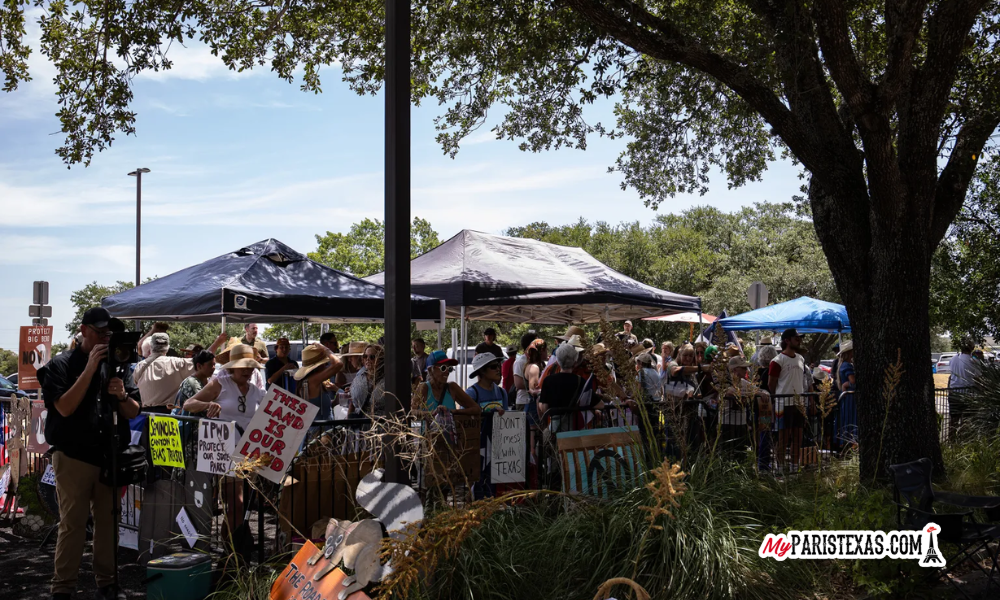
The Texas Parks and Wildlife Commission’s annual public hearing kicked off Wednesday with an unusually festive scene outside the agency’s Austin offices: a tailgate party where hundreds of people from around the state cooked out, shared cold drinks and talked about the reason they’d come — the potential construction of border barriers through state park property in far West Texas.
Cardboard cut-outs of desert animals with slogans like “Don’t fence us in” and “No wall, no wire, no way” lined the walkway leading to TPWD headquarters, mirroring chants from the crowd –– all hoping that the agency that oversees the state park system would finally respond to months of public outcry about the possibility of large-scale federal border wall construction on public land.
Videos of bulldozers tearing into Big Bend National Park have sparked headlines around the world, to the point that Customs and Border Protection Commissioner Rodney Scott personally paused construction until he could conduct an on-the-ground visit to the region.
But the federal government’s plans in neighboring Big Bend Ranch State Park and Black Gap Wildlife Management Area, both Texas Parks and Wildlife properties, are still up in the air. Customs and Border Protection has released little information to the public about its plans for border barrier construction on state land beyond an online map that has changed numerous times without warning.
Despite being one of the most pressing issues facing the agency, border barriers were not included in the agenda for the board’s quarterly meeting. The commission only holds one forum for in-person public comment per year, so organizers seized on the opportunity to speak to commissioners directly.
Mike Davidson, a river guide on the Rio Grande since 1977, said that in all of his years in the backcountry in Big Bend, he’d never once felt threatened by crime on the border. “We don’t see people trying to cross the river while we’re paddling,” he said.
David Long, a longtime TPWD employee and former superintendent of the Barton Warnock Center at Big Bend Ranch State Park, talked about the joys of teaching his grandsons how to safely navigate the river and the harsh Chihuahuan Desert backcountry.
“What is the legacy that we want to leave our future generations?” he asked the crowd. “Memories of how we coexist with nature and protect it –– or a scarred landscape?”
Ninety-nine people signed up to speak at Wednesday’s public hearing and the vast majority wanted to talk about border barriers, including a large contingency from the Big Bend region.
Hillary Pierce, an organizer for No Big Bend Wall, a group dedicated to stopping the construction of border barriers in Customs and Border Protection’s largest and least busy sector, said the pre-meeting tailgate was an attempt to make the gathering feel more like a celebration of Texas parks than a tense confrontation between the public and the commission.
“A lot of people don’t realize that the commission consists of people who are appointed directly by Gov. Abbott himself,” she explained. “In many cases, they are some of his biggest supporters, some of his biggest donors, and have a direct line to him. We’re hoping that they’ll advocate for us and amplify our voices in his ear.”
Former Texas Land Commissioner Jerry Patterson, who has been trying to rally fellow Republicans to the cause, said opposing federal barriers in far West Texas has become a bipartisan cause. “I have yet to encounter anybody in the Big Bend area who does not oppose a wall,” he said.
Source: Sam Karas, , via the The Texas Tribune
Photo Credit: Dozens gather in opposition of border infrastructure projects in the Big Bend region before the Texas Parks and Wildlife Commission’s public meeting in Austin on Aug. 18, 2026. Kaylee Greenlee for the Texas Tribune
The Texas Tribune is a nonprofit, nonpartisan media organization that informs Texans — and engages with them — about public policy, politics, government and statewide issues.