
Texas lawmakers accuse the state broadband office of favoritism and sweetheart deals after satellite internet providers received most of the funding.
When Texas was awarded more than $3 billion to expand broadband services to every corner of the Lone Star state, broadband advocates celebrated.
Fast-forward four years, and that same pool of money has become the subject of tense speculation. Lawmakers have lobbed allegations of favoritism to companies — namely Elon Musk’s Starlink — that are set to receive federal money from an official state office.
Now, with an audit of the state’s Broadband Development Office underway, more questions have come up regarding what exactly the state is planning to do with billions in taxpayer dollars to make sure all Texans have internet access.
What are the allegations facing the Broadband Development Office?
The biggest accusations thrown at the BDO have been around favoritism and transparency in the grant-awarding process for the Broadband Equity, Access and Deployment program, or BEAD.
During a Senate committee hearing last month, Sen. Charles Schwertner, a Republican from Georgetown, said his office heard about the concerns regarding taxpayer money.
One of the issues Schwertner brought up was about how much money was disbursed up-front for BEAD projects. Originally, providers were only expected to receive 10% of the grant money up front, and the rest would be dispersed on a tiered system based on how many subscribers use the service.
That was changed, but only for one kind of company — satellite internet providers.
“We did make a change to the disbursement schedule specifically for low-Earth orbit,” Bryant Clayton, the BDO’s director, told lawmakers.
The changes were made one or two days before the grant was awarded, Clayton said. Schwertner asked what the amount changed to, but Clayton did not give a clear answer.
Schwertner said the favorable terms offered to low-Earth orbit satellite companies prompted other applicants to seek changes to their own disbursement schedules.
Clayton said he was not aware of those requests. Schwertner referred to a signed letter from a coalition of businesses that asked for reconsideration. Clayton said he was familiar with the letter but disagreed that it reflected what they were asking for. Schwertner also said the office was requiring applicants to file Public Information Requests to get information on the award process, which he called an adversarial process. Clayton said it was to put the office on a timeline to respond, but Schwertner called for transparency.
“I have my eye on y’all regarding the way y’all are conducting your business,” Schwertner told Clayton. “I don’t care who’s messing with your business, but we, as an oversight committee, are going to oversee it regarding fairness and transparency.”
How much money is at stake?
More than $5 billion of federal and state money has been dedicated to broadband development funds.
A large tranche of that money — $3.3 billion — comes from the Biden Administration’s Infrastructure bill, which created the BEAD program. Despite U.S. Sens. Ted Cruz and John Cornyn both voting against the bill, Texas was still awarded the most BEAD funding out of any state.
How is Elon Musk involved?
One of the initial requirements for the BEAD program was that all projects had to use fiber optic cables before any other option. That was changed in 2025 when the National Telecommunications and Information Administration adopted a technology-neutral stance that opened the door to satellite companies receiving federal money for broadband development projects.
Musk’s Starlink offers residential broadband service through low-earth orbit, or “LEO”, satellite in Texas on a larger scale than any of its competitors. It has at least 12 million active customers globally. Amazon has begun deploying satellites for its own LEO service, Amazon Leo.
Both Starlink and Amazon were listed as subgrantees for the BEAD program on the comptroller’s website, though it did not state how much money was awarded. Musk, who was recently named the world’s first trillionaire, has reportedly received at least $38 billion in government contracts, loans, subsidies and tax credits.
During the hearing, Sen. Nathan Johnson, a Dallas Democrat, expressed his concerns about Musk, who he says has “tremendous control” over the federal government.
“The federal government issues some new edict, and the award happens to go to 99% of his companies which are priced at three times what other companies are pricing,” Johnson said. “I understand there’s probably deficiencies, and there may be a perfectly logical explanation. I hope there is.”
Source: Jayme Lozano Carver, The Texas Tribune
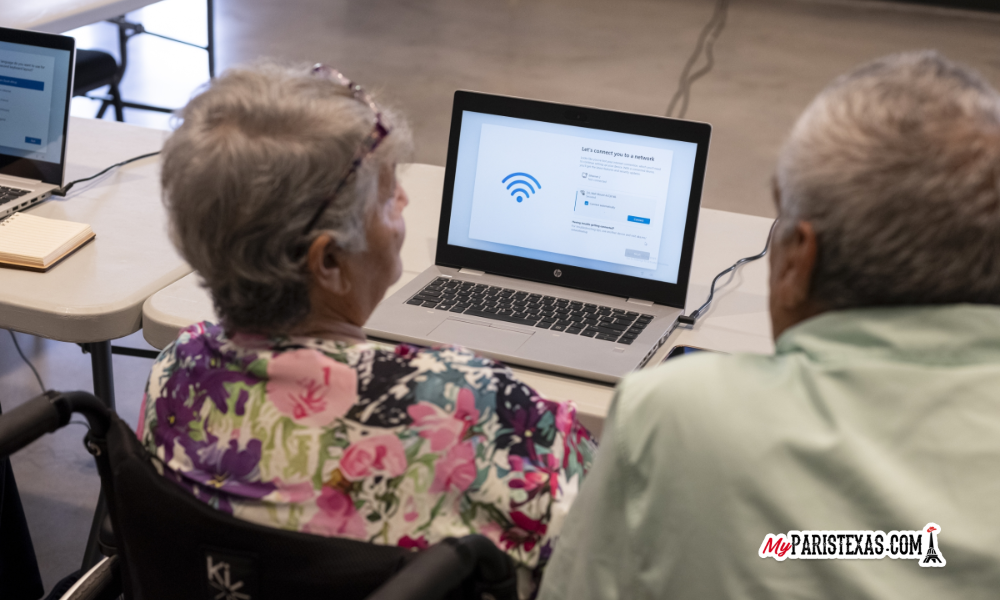
Photo Credit: Bastrop County residents attend a a class through Bastrop Cares aiming to educate residents about technology on June 2, 2026. Ilana Panich-Linsman for The Texas Tribune
The Texas Tribune is a nonprofit, nonpartisan media organization that informs Texans — and engages with them — about public policy, politics, government and statewide issues.