
The incumbent senator and his allies have massively outspent the pro-Paxton side, though polling points to a tight finish in the May 26 election.
From the jump, the battle for the Republican U.S. Senate nomination has featured a massive cash imbalance, with incumbent U.S. Sen. John Cornyn and his allies in Senate GOP leadership unleashing millions in ads to pull him to a first-place finish in the March primary over Attorney General Ken Paxton.
That financial disparity has persisted in the runoff after neither Cornyn nor Paxton broke 50% of the vote in round one. Through Wednesday, pro-Cornyn forces had outspent the Paxton side more than four to one, according to media tracking firm AdImpact, allowing the incumbent senator’s allies to dominate the airwaves with ads attacking Paxton, a warrior of the far right, as incompetent, corrupt and adulterous.
Lackluster fundraising on Paxton’s side, meanwhile, has handicapped his ability to counter that messaging on TV, though he has ramped up his airtime in the week ahead of early voting, which begins Monday. Paxton’s spots in the runoff have tagged Cornyn as a generational relic, weak on red-meat issues and an ally to Democrats.
The spending gap, while still large, has narrowed since the first round, when pro-Cornyn groups — including Senate Republican leadership, which has been quieter on the airwaves in the runoff — spent $69 million, roughly 17 times as much as Paxton and his allies. Some of that paid for attack ads against U.S. Rep. Wesley Hunt of Houston, who placed a distant third in the March 3 primary after coming under fire from both sides.
Source: Kayla Guo,
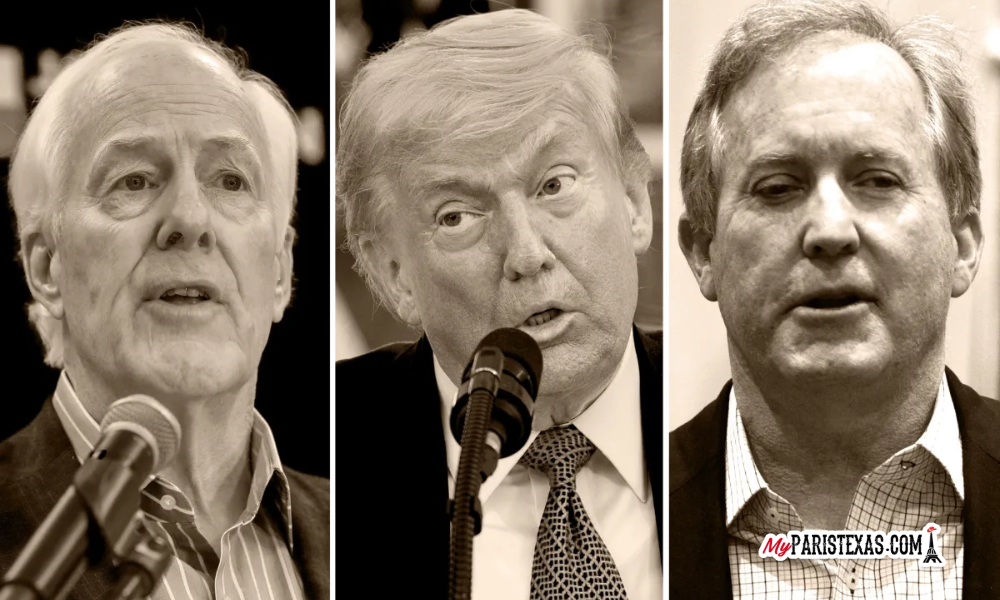
Photo Credit: From left: U.S. Sen. John Cornyn, President Donald Trump and Texas Attorney General Ken Paxton. Cornyn and Paxton are locked in a tight runoff for the Republican nomination for Senate; Trump has so far endorsed neither. Bob Daemmrich for The Texas Tribune | Sipa USA via REUTERS | Pheobe Terry for The Texas Tribune
The Texas Tribune is a nonprofit, nonpartisan media organization that informs Texans — and engages with them — about public policy, politics, government and statewide issues.