
President Trump, who wants to stop profit-driven companies from buying residences in bulk, spotlighted the struggles of a Houston woman who was regularly outbid by firms on homes in the pandemic.
In 2020, Raysall Wiggins decided she no longer wanted to rent a home in the Houston neighborhood where she grew up. She wanted to buy.
“I wanted to have something of my own, something that I could eventually pass down to my children,” said Wiggins, who has two teenage sons. “My parents never had that, and I wanted something different for my own children.”
Wiggins, who works in health care, put in multiple offers on homes in Houston’s Acres Home neighborhood. But more times than not, she was beaten not by another family, but by an investor or company, her real estate agent said.
“It’s devastating to continuously go through the same thing, for a person to constantly be told, ‘no’ or ‘we didn’t get it,’” Wiggins said. “It’s a complete letdown.”
President Donald Trump highlighted Wiggins’ story as he pressed lawmakers at his State of the Union address to bar so-called institutional investors, large corporations that buy homes, as well as investors big and small, from purchasing single-family homes.
Trump blamed investors for “stealing away her American Dream.”
Homeownership is viewed as the most accessible way for Americans to build wealth. By that measure, the idea of corporations owning homes is offensive to Americans, said Daryl Fairweather, chief economist at Redfin, an online real estate brokerage. Going after them carries populist appeal.
But, she and other housing economists said, such a prohibition does not attack the root of the nation’s housing problems.
“Declaring a ban on institutional investors works as a political talking point,” Fairweather said. “It works in terms of it emotionally resonating with people who understand the problem but don’t necessarily understand what the right solution is. The real solution, which is to build more homes in the places that people most want to live, is much harder for the President to achieve.”
Republicans, including Trump, and Democrats, including Sens. Bernie Sanders and Elizabeth Warren, have sought to cast blame on Wall Street and other kinds of investors driving up home prices and making it too hard for would-be first-time homebuyers out of the market.
They’ve sought ways to give first-time homebuyers a leg up in the housing market. Trump signed an executive order in January aimed at discouraging federal agencies from facilitating sales of homes to large institutional investors. Trump called on Congress during his State of the Union address to make that ban permanent. Senators are expected to vote on a bill this month that would limit firms from owning more than 350 single-family homes.
Texas officials, too, have shown an appetite — including Gov. Greg Abbott and state Rep. Gina Hinojosa, an Austin Democrat challenging Abbott in this year’s gubernatorial race — to curb investors from buying up too many homes.
Kicking Wall Street out of the housing market, housing economists argue, wouldn’t blunt the country’s affordability problems — and could make the problem worse.
For one, estimates show large institutional investors own only a small percentage of the nation’s stock of single-family homes — between 1% and 3%. Investors have pulled back considerably since the height of their activity during the pandemic and are now selling more homes than they buy. Those homes aren’t just sitting there — they’re rented to tenants who may not be able to afford to purchase them.
“When you ban institutional investors, you’re potentially banning the people who might not otherwise have access to local schools in single-family neighborhoods or other amenities in those neighborhoods,” Fairweather said. “That reinforces income segregation and racial segregation.”
The primary driver of the nation’s high housing costs, experts have argued, is a deep shortage of homes to buy or rent. By various tallies, the nation is short millions of housing units. Texas, in particular, needs 319,500 homes of all kinds, according to one oft-cited estimate. Banning institutional investors from buying homes, or at least making it more difficult for them to do so, would do nothing to create more homes.
Source: Joshua Fechter,
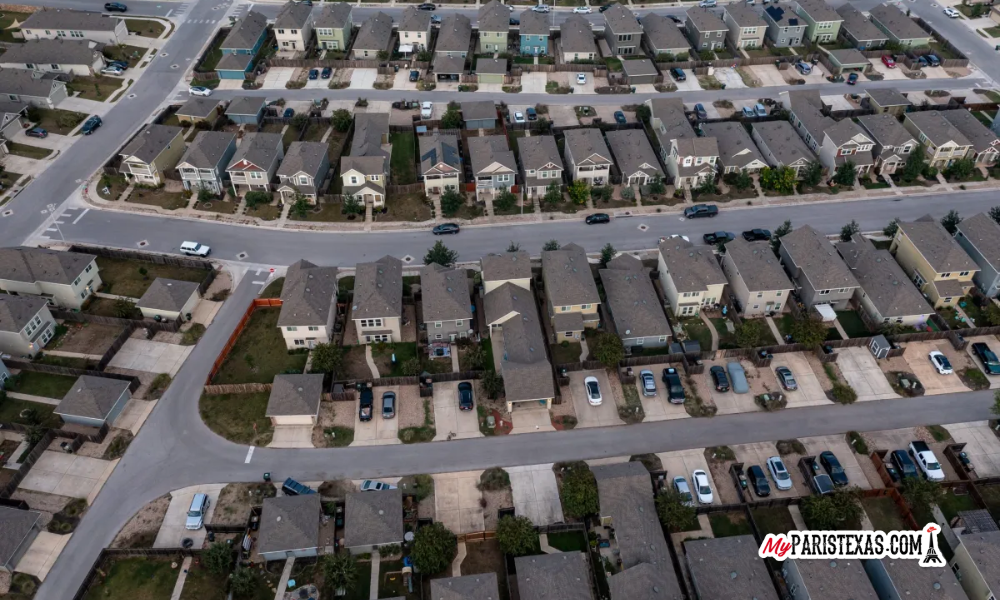
Photo Credit: Republicans and Democrats from Austin to Washington want to ban investors from buying homes. Experts said that policy would do little to drive down costs. Jordan Vonderhaar for The Texas Tribune
The Texas Tribune is a nonprofit, nonpartisan media organization that informs Texans — and engages with them — about public policy, politics, government and statewide issues.