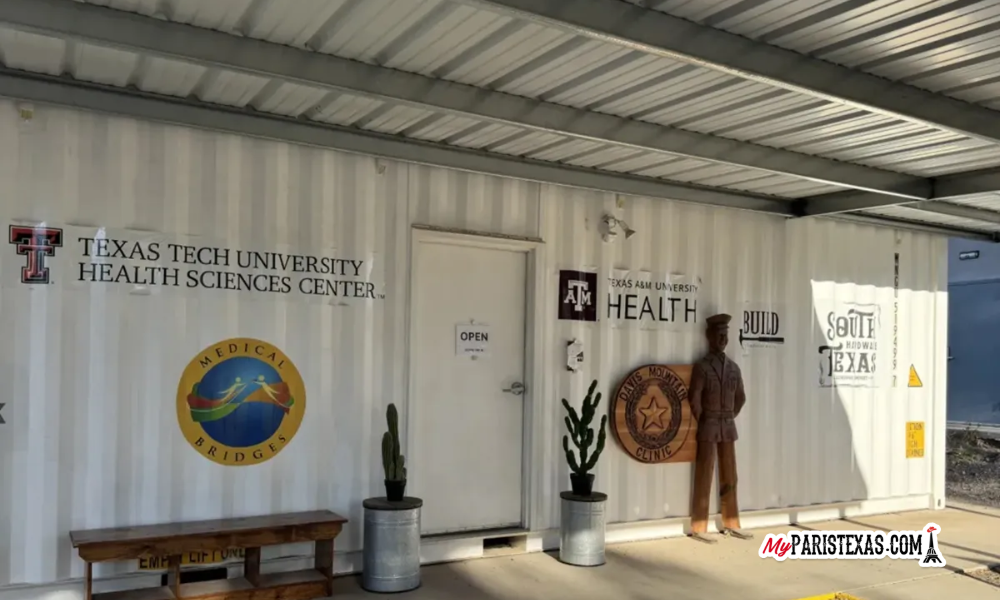

A new approach aims to tailor telehealth to the realities of an older, rural population by offering a physical place with reliable connectivity and an on-site nurse.
A shipping container in Fort Davis is at the center of a new experiment in bringing telehealth to an aging rural population.
Perched in the Davis Mountains of West Texas, Jeff Davis County faces steep barriers to care. Nearly one in five residents lacks reliable broadband. The only doctor in Fort Davis, the county seat, is semi-retired, and most people make the 30-minute drive to Alpine for care. With a median age of 58, among the highest in the country, the need for consistent medical care is growing, even as access, both in-person and virtually, remains a challenge.
The retrofitted 40-foot container houses the new Davis Mountain Clinic in Fort Davis, a telehealth hub created through a partnership between Texas A&M and Texas Tech universities to connect residents with remote medical and mental health professionals.
But for rural Texas, expanding telehealth for aging populations depends on more than video calls. It requires reliable broadband, digital literacy for older residents, trusted community health workers, and practical ways for clinicians to weave virtual visits into everyday care.
Since opening in October 2025, the Davis Mountain Clinic has added something many rural telehealth programs lack: a physical place with reliable connectivity and a local registered nurse, Carol Brewer, who can take vital signs, perform physical exams, and guide patients through virtual visits with providers who may be hundreds of miles away.
Brewer, who is also the director of the clinic, said this approach creates a whole new world of access for the community, especially for older patients who may feel less comfortable navigating virtual appointments.
“The majority of the patients I see are part of an older population,” Brewer said. “The advantage is, when they come here to see the doctor, I manage the technology on my end, they don’t have to deal with that at all…I’m the hands of the physician via telehealth. I have a stethoscope and an otoscope. So they can hear their lung sounds, heart sounds, bowel sounds, or look in their eyes, ears, nose. I facilitate that.”
Brewer’s hands-on approach highlights how telehealth can be tailored to the realities of an older, rural population, where technology alone isn’t enough, and personal guidance can make the difference between care received and care missed.
“People who live in rural areas are older, sicker, and poorer than people who live in urban areas. Because of that, there are absolutely practical applications for telehealth and its clinical applications,” said Billy U. Philips, PhD, the former executive vice president of the The F. Marie Hall Institute for Rural and Community Health and current Grover E. Murray Professor at Texas Tech University. “But when you overlay with age dimension, then the delivery of care is really going to depend on local and personal circumstances.”
Brewer sees the importance of local connection and community in her work every day.
“I had a patient that came and saw the doctor [virtually] yesterday. His wife had dropped him off, and I gave him a ride home afterwards, because his wife had to go down to Alpine,” Brewer said. “There are just things that we can do for the patients that they’re not going to get anywhere else.”
Brewer said that even though the county has just 1,200 residents, she often sees several patients each day. Some come for virtual appointments, while others need help managing aging-related care, navigating insurance, or even obtaining copies of their medical records.
“I had a patient whose daughter came by and said she didn’t think her mom looked well, and her vehicle was out of commission, so she couldn’t get her to the doctor. I went to their home and checked on her mom, and sure enough, her oxygen levels were low and she wasn’t wearing her oxygen,” Brewer said. “We got her back on [the oxygen] and stabilized her, and while I was there, I called to set up a doctor’s appointment. The daughter was arranging another way to get her mom to the doctor. It’s a small community, so if they can’t come to me, I go to them.”
This hybrid delivery of care offers hands-on support while also connecting a rural community to specialists and providers in different corners of the state.
Technology challenges
A 2025 report from the Texas Broadband Development Office found that Jeff Davis County faces significant broadband challenges due to its small, aging population, mountainous terrain, and high proportion of residents with disabilities or limited English proficiency. These factors make deploying reliable, affordable internet costly and complex, often requiring public subsidies to make broadband expansion feasible.
But these hurdles aren’t unique to Jeff Davis County.
In rural parts of Texas’s Coastal Bend, along the Texas Gulf Coast, available broadband is not equivalent to reliable broadband.
“Even if you pay for the platinum packages, you may at best receive only so-so service,” said Amy Kiddy Villarreal, director of the Coastal Bend Aging and Disability Resource Center. “Internet availability and quality are among the biggest hurdles [to accessing telehealth].”
Philips said that across rural Texas, broadband is often limited, unreliable, and costly, creating obstacles for telehealth and other digital services. While commercial expansion may improve access over the next decade, for now some residents rely on shared community spaces, like clinics, senior centers, and libraries, to get online.
These hubs not only provide connectivity but can also offer guidance for older or less tech-savvy residents, helping them navigate the digital tools they need for health care and daily life.
Highlighting the practical challenges of expanding connectivity, Philips emphasized the need for flexible solutions that give rural residents real choice: “The question now is: how do we get things done in such a way that rural populations have choice and have competitive pricing, and have places where they can have access, even if it isn’t in their home?” he said.
This effort is underway in the Coast Bend region.
Source:Madeline de Figueiredo,
Photo Credit: The Davis Mountain Clinic in Fort Davis, housed in a shipping container, serves as a telehealth hub, with hands-on support, to connect residents with remote medical and mental health professionals. Carol Brewer
The Texas Tribune is a nonprofit, nonpartisan media organization that informs Texans — and engages with them — about public policy, politics, government and statewide issues.