
Over 5,549 wildfires ignited in Texas in Fiscal year 2025, with Texas A&M Forest Service responding to 690 fires for 95,086 acres.
Wildfire investigations
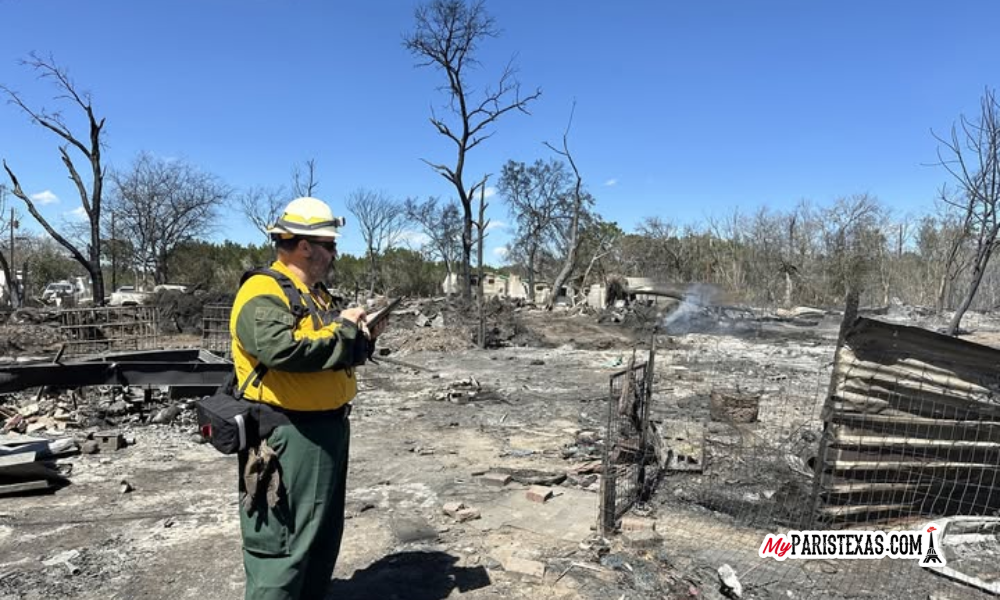
As wildfires are controlled by wildland firefighters, a different type of crew also arrives on scene—Texas A&M Forest Service investigators, who are tasked with finding the cause and origin of the wildfire. They can investigate wildfires that the agency or local fire departments respond to. In FY25, they investigated 149 Texas wildfires.
Texas A&M Forest Service investigators operate in the same tiered response approach as wildfire response, often being called to the scene when local authorities are unable to find a cause and origin, if the cause is unknown or if the cause is suspicious.
“Our priority is arriving on scene before it is disturbed by heavy equipment, mop-up operations and weather conditions like rain or snow,” said Connor Murnane, Texas A&M Forest Service Law Enforcement Chief. “These conditions can lead to an undetermined cause.”
Investigators begin their investigation at a point that is most disturbed by the fire and work inward, using key fire indicators to work toward the area that is least disturbed, leading to the general area of origin.
In East Texas forests, investigators use indicators like the angle of char on pine bark to indicate the direction that the fire came from and the direction it was moving. In grasslands and non-forested areas in other parts of the state, investigators predominately rely on grass stems, serving as backing and lateral fire indicators.
Once the origin and cause are determined, investigators share their findings with local officials and the Railroad Commission of Texas and Public Utilities Commission of Texas respectively if the fire involved oil, gas, railroad or utility infrastructure. In cases of arson, investigators may open a full arson investigation to identify a suspect and pursue criminal charges.
Collaboration to prevent future wildfires
Not only do wildfire origin investigations attempt to bring a sense of restitution to the affected community or justice in cases of arson, but they are also critical to the creation of statewide wildfire prevention and mitigation strategies.
Texas A&M Forest Service investigators work with wildfire prevention and mitigation specialists to share investigation data to be used in targeted messaging campaigns. These specialists look for trends in wildfire causes such as campfire, equipment operation or debris burning—the leading cause of wildfire across Texas.
As trends emerge, specialists deploy digital and physical messaging, including billboards, gas station pump videos and radio and TV public service announcements. Since these specialists are located statewide, they also use on-the-ground presence and messaging to connect with communities.
“Our teams work cohesively to understand why wildfires are starting across the state so we can accurately direct our messaging to target those topics specifically,” said Erin O’Connor, Texas A&M Forest Service Mitigation and Prevention Department Head.
Post-fire assessment
A third team that plays a role in the wildfire review process is the post-fire assessment team, comprised of agency fire experts. Following wildfires, this team visits properties affected by fire to analyze how homes and properties were damaged or lost, the conditions of the surrounding environment, the building materials used and any signs of previous mitigation efforts by home and property owners that slowed the progression of the fire.
This analysis is used in prevention and mitigation messaging and in some cases, is also turned into case studies to be shared with local and state officials and home and property owners. Some communities utilize these case studies to work with Texas A&M Forest Service to create a community wildfire protection plan, apply for the community wildfire defense grant program or earn the Firewise USA®’s Firewise Community status.
“All of the processes we deploy for wildfire response, investigation and analysis aim to ensure that we are helping mitigate against preventable wildfire starts, spread and loss,” said O’Connor.
Article source and photo credit: Texas A&M Forest Service