
Federal cuts and high food prices, particularly with poultry and other proteins, strain local pantries as demand from families in need surges.
Turkey, ham, cranberry sauce and dressing are all staples for the dinner table during the holidays, but this year, millions of Texas families who rely on food banks will find their tables empty of traditional festive foods.
Texas food banks face the highest demand they’ve seen since the 2020 pandemic, but high food prices, a dearth of federal funding and fewer donations have crippled their ability to provide much-needed nourishment to struggling families.
“This is the first year we bought zero turkeys. They’re just too expensive,” said Brian Greene, president and CEO of the Houston Food Bank.
From February to June 2026, calls seeking food assistance from the Texas Health and Human Service’s 211 assistance hotline increased 28%, while referrals to food banks and food pantries rose nearly 37%, from 4,230 to 5,785 referrals, according to data from United Ways of Texas.
“Part of the phenomenon we are seeing is that the pantries are having to spread the peanut butter thinner, leaving families to see who else can help them,” Greene said. “We have seen a 20% increase in requests for food assistance and a 10 increase in people being served in our network of charities in the Houston area.”
Texas’ safety net for food insecurity includes federal nutrition assistance programs such as the Supplemental Nutrition Assistance Program, as well as food banks and school programs.
A food bank is defined as a regional nonprofit that sources, stores and distributes food to local programs in the communities it serves, including pantries, school programs and more, making it the backbone of the hunger-relief system. Twenty food banks serve over 4 million Texans annually through a network of more than 4,000 partners.
However, the food bank system is not meant to address all food insecurity in the state because most of its resources come from philanthropy, but that is exactly what is starting to happen as federal assistance declines.
Rural food banks, in particular, face a dire situation because of the large migration of families from urban areas into their regions. They can’t keep up with demand, much less afford the high prices for turkey, ham and other proteins.
The High Plains Food Bank is having its worst food crisis in its 40-year history, said Zack Wilson, executive director of the High Plains Food Bank, which primarily serves rural families.
“We are serving over 14,000 households for a month now, which on average is, is a record number of households. We are serving the most we’ve ever served, but with probably the least amount of inventory,” Wilson said. “We bought some turkeys early, but they went fast. Once the inventory is gone, it’s gone.”
The holiday season puts extra strain on low-income families since children don’t receive their free and reduced lunch at school when their schools are closed, leaving parents to turn to food banks and pantries for help. However, the number of food-insecure families is growing much faster than the available food supply, leading to rationing or changes to holiday meals when demand is highest.
Food insecurity is defined as when a household lacks money or resources to reliably access adequate food. Earlier this year, Feeding America, the national network of food banks, released its 2026 Map the Meal Gap study, which uses 2024 data. The study found that 19.4% of Texans, or nearly 1 in 5, are experiencing food insecurity, and 1 in 4 Texas children are experiencing food insecurity, representing 26%, or nearly 2 million children.
“I was talking to a donor who told us she had a family member who had a good job, a good wage, and yet couldn’t provide for his family at times due to the increasing cost of insurance and fuel,” Wilson said.
“The driving factors here are inflation and rising costs of everything with food and fuel being the top drivers. Our fuel bill alone is up 220% this month compared to January so everybody is feeling it,” Wilson said. “Bundle that with utilities when we had one of the hottest summers we’ve ever had in the Texas Panhandle and the past two years we’ve had natural disasters from fires to flooding to tornadoes and it has been a rough stretch for everyone and making it harder and harder to survive these days.”
What is happening at the High Plains Food Bank is one example of the mounting pressure food banks face as demand for food increases each month.
“The worst-hit regions are in the Panhandle, Lipscomb, Hemphill, and Sherman counties, as well as parts of West and North Texas, but this is a problem statewide,” Greene said. “It’s scary.”
Sari Vatske, president and CEO of Central Texas Food Bank said urban-to-rural migration in Texas is putting particular pressure on rural food banks because they are often the nearest food source for families.
“The need has increased since the beginning of the year as the holidays are upon us and the cost of living remains high,” she said.
Source: Texas Tribune BY Stephen Simpson
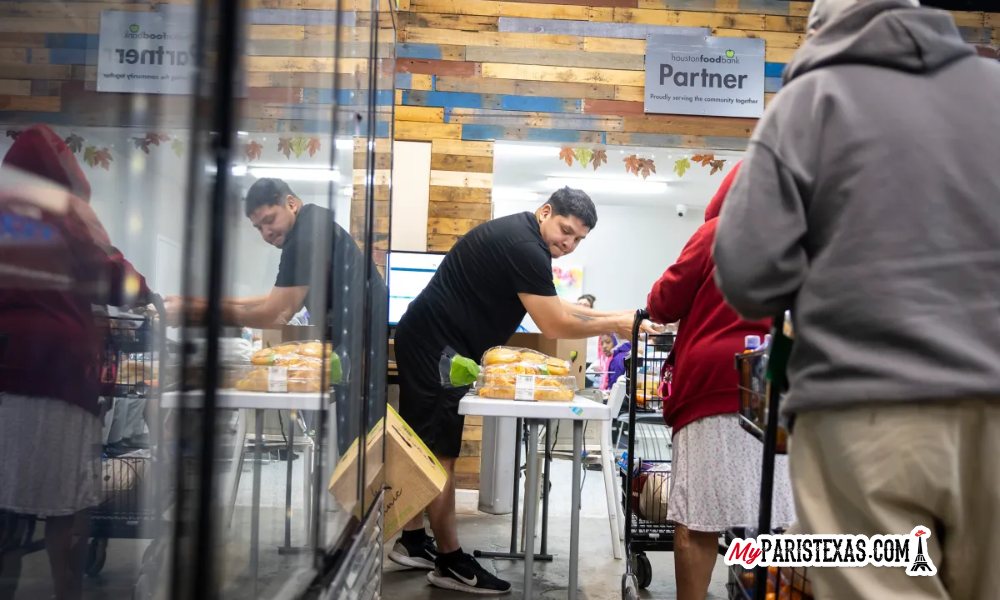
Photo: Volunteer Isaias Maza, center, helps a client with a cart full of groceries at the Wesley Community Center food pantry on Nov. 24, 2026, in Houston. Annie Mulligan for The Texas Tribune