
As the U.S. pushes to reduce reliance on foreign suppliers, Texas companies prepare to capitalize on the state’s emerging lithium industry.
TEXARKANA — When Scott Norton became president of the TexAmericas Center, he hoped the industrial park would attract employers that would bring much-needed jobs to North East Texas.
Little did he know the industrial center would sit atop one of the country’s largest and richest lithium deposits, known as the Smackover Formation, and would also become a key location for mineral production in Texas.
“[Lithium production is] a great opportunity not just for the Department of War and Red River Army Depot, but in the entire region when it comes to capital investment and job creation,” Norton said.
Lithium production in East Texas could create high-paying jobs, support local businesses and encourage cities to improve East Texas infrastructure, such as roads or public utility services. But it could also leave landowners struggling with high property values and a community dealing with infrastructure that doesn’t keep pace with rapid growth, leading to a bust that the state has seen before with the oil and gas industry.
Economists at a Texarkana lithium symposium in July warned against vying for a boom, and encouraged leaders instead to seek slow, sustainable growth.
Now, however, local officials and state lawmakers must decide how to manage the industry to ensure that landowners’ rights are respected, that the extraction process remains safe and clean, and that producing this mineral in East Texas is worth the cost.
“We can learn from Arkansas and from some of these other places, but it has to make sense economically for companies,” said Brent Elliott, an economic geologist and mineral resource specialist with the Bureau of Economic Geology at the University of Texas. “They won’t do it if there’s not some kind of incentive or clarity on the landscape, like ownership, unitization and the production procedure. And then the economics of it at the end of it.”
Next year could prove to be a crucial year for this budding industry, if lawmakers make it a priority in the 2027 legislative session.
Who will manage lithium rules and regulations?
Lithium production is a national issue with wide-reaching implications. Landowners near production facilities have a stake in the game, as do producers such as EnergyX, ExxonMobil and Chevron, local officials and state and national lawmakers.
President Donald Trump and Texas’ congressional delegation are pushing to expand domestic mineral production and reduce the nation’s reliance on foreign countries for critical minerals. Right now, the Environmental Protection Agency oversees federal regulations on mineral extraction.
In Texas, lithium mining regulation is overseen by the Texas Railroad Commission, which also oversees the state’s oil and gas production, use and waste. The agency was given rule-making authority in 2023 and established some guidelines based on the oil and gas industry, and brine production.
Industry players would like to see some clarity on important issues, such as property tax values, royalties and brine injection regulations, either from the commission or from state lawmakers.
Researchers at the Bureau of Economic Geology at the University of Texas, including Elliott, plan to present lawmakers with findings on the industry, such as water rights and mineral royalties, by the end of the year to help lawmakers form decisions on this emerging industry.
“We’ll try to get to anyone who represents East Texas,” Elliott said. “Anyone who has jurisdiction over the Smackover or anybody who’s on the Natural Resources committees, both in the House and Senate, or the Energy Committees. Those folks would do well to understand the current landscape and the recommendations for making it better.”
This issue also touches on local economic development, which is why the Texarkana Chamber of Commerce hosted its first-ever lithium symposium, at which experts provided more insight on the industry to regional and state leaders. It even brought Arkansas Gov. Sarah Huckabee Sanders to Texas to open the symposium.
Lithium production in Arkansas has grown exponentially over the last few years as companies pull brine from the Smackover Formation, which spans from Florida to Central Texas. Because brine production was already common in Arkansas, lithium production rules and regulations were folded into an already established framework.
Arkansas’ regulations were cited in both the symposium and multiple independent interviews with the Texas Tribune as a solid source for Texas to base its own regulations on.
“They seem to be very happy with the structures in place in Arkansas, and would like to see more structures in the state of Texas,” said Robin Hickerson, president and CEO of the Texarkana Chamber of Commerce.
Economic implications
Texas’ reputation as a business-friendly state could encourage lithium producers to create high-paying jobs for out-of-work oil and gas workers since both industries require similar skillsets. It could also encourage tertiary development, such as retail, restaurants and hotels, in underdeveloped areas.
Source: Jess Huff, The Texas Tribune
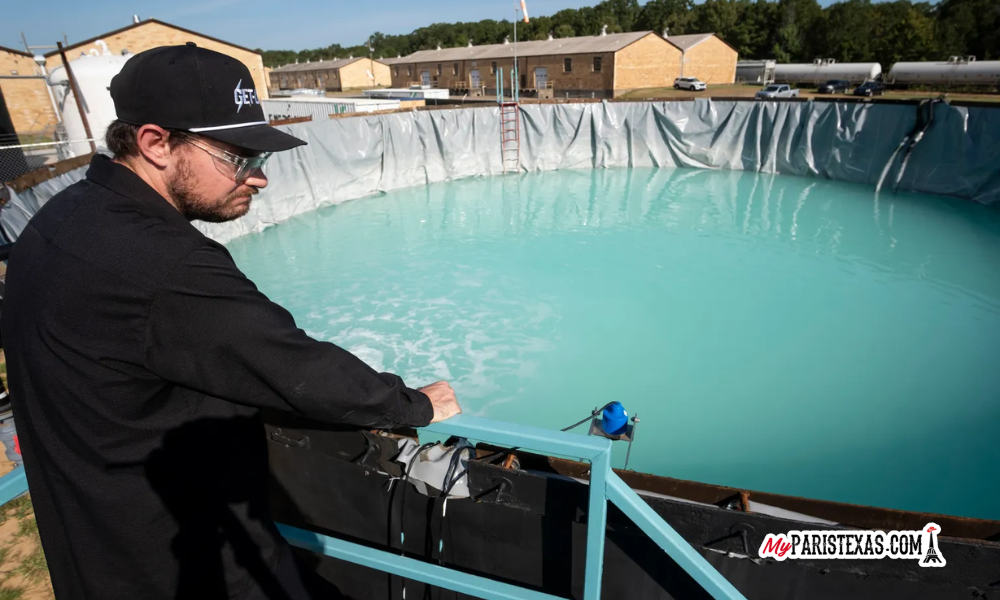
Photo Credit: EnergyX Solvent Extraction Manager Jacob Helper shows off a frack pond filled with water post-lithium extraction while speaking about the company’s direct lithium extraction process, on Wednesday August 19, 2026, at their Hooks location. Hooks is a small town in Bowie Co., about 15 miles west of Texarkana. Michael Cavazos for The Texas Tribune
The Texas Tribune is a nonprofit, nonpartisan media organization that informs Texans — and engages with them — about public policy, politics, government and statewide issues.