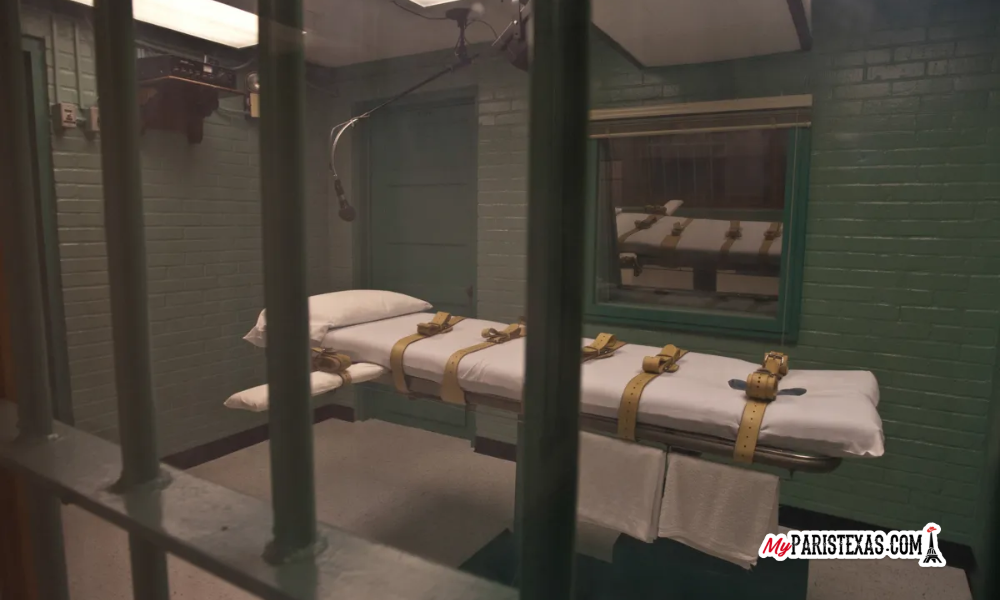

Edward Busby was executed by lethal injection Thursday, reinforcing Texas’ position as the nation’s leader in capital punishment.
Texas executed its 600th inmate Thursday evening, administering a lethal injection to Edward Busby in Huntsville and reinforcing its status as the nation’s leading death penalty state even as the pace of executions continues to slow.
Florida is a distant second, having executed 131 people since the U.S. Supreme Court reinstated the death penalty in 1976.
Busby, convicted in 2005 in the deadly robbery and kidnapping of 78-year-old Laura Crane, had been granted a stay of execution last week when a federal appeals court cited concerns about his eligibility for capital punishment because of intellectual disability.
The U.S. Supreme Court lifted the stay Thursday afternoon over the objections of the court’s three liberal justices, and Busby was escorted into the death chamber in Huntsville later that evening.
In his final statement, Busby apologized repeatedly for Crane’s death and said he “never meant anything bad to happen to her.”
“I am so sorry for what happened. … Miss Crane was a lovely woman. I never meant anything bad to happen to her,” he said. “I’ll take the blame if it will help.”
Busby was declared dead at 8:11 p.m., 43 years and 5 months after Texas executed its first inmate in the modern era — Charlie Brooks Jr, who was also the first person in the U.S. to be put to death by lethal injection. Brooks’ sentence set Texas on a path toward becoming the nation’s leader in applying the death penalty, putting more inmates to death than the next four states combined.
Most of Texas’ 600 executions occurred in a span of about a decade around the turn of the century, when the state was executing upwards of 40 people a year. And while the state’s use of capital punishment has dwindled in recent years, certain trends continue, including a pronounced geographical tilt.
Roughly half of the inmates executed in Texas were sentenced to death in four of its 254 counties: Harris, Dallas, Tarrant and Bexar. Harris County alone has seen 138 of its death sentences carried out, more than any of the 49 states not named Texas.
Kristin Houlé Cuellar, executive director of the Texas Coalition to Abolish the Death Penalty, has described the phenomena as a “lethal lottery” in determining which of the state’s capital murder cases receive a death sentence.
“Zip code is essentially the number one determining factor [of] whether the death penalty is going to be sought in an individual case,” Cuellar said. “That trend is persistent throughout Texas’ 44-year history of the death penalty in its current iteration, but it’s even more pronounced now.”
Like Brooks almost 44 years ago, Busby was convicted in Tarrant County, the No. 3 Texas county for executions and No. 2 in the number of inmates on death row, said Burke Butler, executive director of the Texas Defender Service, an advocacy organization that helps represent those with capital convictions.
“When we look at the death penalty in Texas, we’re increasingly looking at the story not of a state that is a voracious seeker of the death penalty, but a handful, a tiny handful of counties that are voraciously seeking this punishment,” Butler said. “Tarrant County is truly one of the leaders when it comes to that.”
Tarrant County surpassed Bexar County in March with the execution of Cedric Ricks, convicted in 2014 for stabbing his wife and her 8-year-old son to death. Tarrant County has sought more death sentences at trial than any other since 2020, according to the Texas Defender Service.
Death penalty opponents also say executions are disproportionately applied against defendants of color, particularly black men, who accounted for almost 36% of Texas’ executions since 1982. Black Texans represent roughly 12% of the state population, according to the Texas Demographic Center.
Three of the four defendants executed in Texas this year so far, including Busby, were black men.
Anthony Graves, one of 18 men who have been exonerated after spending time on Texas’ death row, said he believed racism contributed to his wrongful conviction and death sentence. Graves spent 16 years on death row and two more in prison after being convicted of killing a family in Somerville and setting fire to their home. During his trial, then-Burleson County District Attorney Charles Sebesta withheld an admission from Graves’ co-defendant, Robert Carter, that he had committed the murders alone.
Sebesta also falsely stated in court that Graves’ girlfriend, who was expected to present an alibi for Graves, was a suspect in the case. She refused to testify after the statement was made. Sebesta was later disbarred for prosecutorial misconduct related to Graves’ case.
In an interview, Graves said he felt the prosecutor’s misconduct “ran [him] through the system” because he is black. But while he believed his trial was influenced by racism, the dehumanization became universal once he and others arrived on death row.
“They took a piece of cloth, and cut out a case, and attached me to it and tried to murder me. That was race,” said Graves, who now runs the Peer Navigator Project, which trains attorneys and inmates on how to navigate appeals.
“I know it was race, but behind those walls has nothing to do with race. You see black people, you see white people, you see Hispanic people, and everybody’s down there to be murdered,” he said.
Source: Ayden Runnels,
Photo Credit: The Texas execution chamber in Huntsville. Texas Department of Criminal Justice
The Texas Tribune is a nonprofit, nonpartisan media organization that informs Texans — and engages with them — about public policy, politics, government and statewide issues.